Bi Gan
比干Prince Bi Gan · The Seven-Orifice Heart
Grand Counselor of Shang, Lord of the Wenqu Star
A Shang grand counselor and royal uncle of King Zhou, killed on Daji's demand for his seven-orifice heart. His death became one of the dynasty's defining crimes, and he was apotheosized as the Lord of the Wenqu Star.
Literary talent, scholarship, and the judgment of the unjustly slain
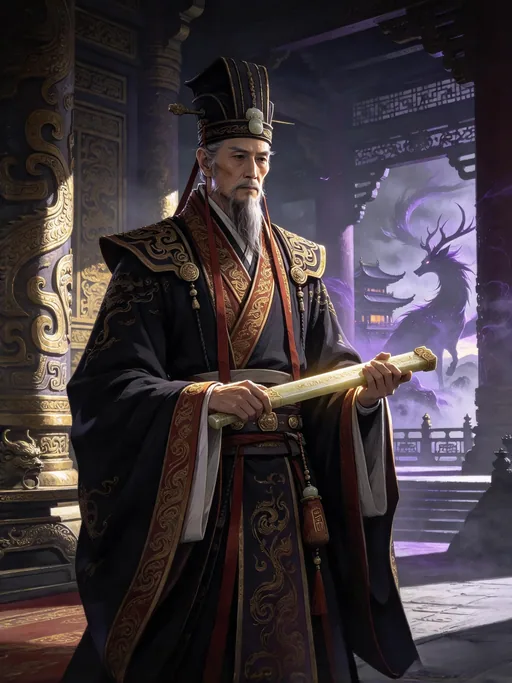
One of the Three Benevolent Men
Bi Gan is a prince of the Shang royal house, a son of the previous king and an uncle of King Zhou. The novel places him in the small circle of senior ministers whose duty is not to command armies but to speak to the throne. He is the grand counselor of the court, and with Jizi and Weizi he belongs to what later tradition calls the three benevolent men of the Shang — three royal kinsmen who, in the last years of the dynasty, tried to save it by remonstrance and failed.
Unlike Huang Feihu, he never defects. He is not a general with a private army, and he has no western border to flee to. His entire political existence is the court, and his only weapon is the memorial. That makes him the novel's purest case of the loyal minister destroyed by the very institution he is trying to preserve: he dies inside the palace, at the command of his own nephew. His death is therefore not a battle casualty but a judicial murder dressed as a medical prescription, and the novel treats it as one of the founding crimes of the Shang collapse.
A Heart No One Can See
The novel gives him very little physical description. He is a court official, and his visual identity is the visual identity of the Shang bureaucracy: layered robes, a jade tablet held before the chest, a formal cap, and the composed face of a man who has spent decades speaking carefully in a dangerous room. He is not armed and carries no treasure.
His one extraordinary attribute is internal — a heart with seven openings, which in the physiognomic tradition marks exceptional intelligence and moral perception. The heart is not visible; it becomes visible only when it is cut out, and that is the point. His imagery is an imagery of interiority: what makes him valuable is precisely what cannot be seen, and the king destroys it precisely because he cannot see it. Two objects carry the rest of his meaning. The fox-fur robe: after the foxes of the Xuanyuan Tomb are burned out of their den, he has the intact pelts made into a robe and presents it in the snow — a silent, devastating warning aimed at Daji. And the heartless vegetable, the basket of greens sold in the street after his flight: an ordinary thing whose power is entirely linguistic, since it lets a question be asked aloud, and it is the answer rather than the blade that kills him.
The Burning of the Fox Den
His fatal entanglement with Daji begins with a banquet. With the Deer Tower completed, Daji summons her kin — the pheasant spirit Hu Ximei and a host of foxes — to appear at the tower as immortals descended from heaven, and Bi Gan serves as the banquet's official host. Pouring the royal wine, he notices an unmistakable fox stench, and as the weaker spirits grow drunk their tails drop into view under the moonlight. The guest list is a den of foxes.
He leaves the tower and reports what he saw to Huang Feihu, who organizes the response: his men shadow the departing guests to a stone cave beside the Xuanyuan Tomb, the ancient tomb of the Yellow Emperor some thirty-five li south of the capital, and three hundred soldiers pile firewood against the mouth and burn. Then Bi Gan does something colder — he has the intact pelts made into a fur robe and presents it to the king in the first snow, knowing Daji will see the skin of her kin worn as tribute. In her eyes this is a massacre of her kind, made personal by the robe, and from that chapter onward she has a private reason to destroy him that has nothing to do with politics. It is the novel's characteristic move: the great political crimes of the Shang are set in motion by small intimate grievances. Officials burn a fox den to clean up a palace banquet; Daji answers by arranging for a heart to be cut out. A dynasty falls partly because of a burned hole in the ground.
The Demand for the Heart
Daji's revenge takes the form of an illness. She falls sick, retching blood, and Hu Ximei declares that the only cure is a decoction made with a piece of a seven-orifice heart taken from a living man. King Zhou, who cannot imagine denying her anything, is told that the only heart in the realm that qualifies belongs to his royal uncle, and the summons goes out six times over.
What follows is the novel's most concentrated study of the loyal minister's dilemma. Bi Gan does not flee and does not raise a rebellion. He goes to the palace, stands before his nephew and speaks — of his service, of the family bond, of the difference between a sovereign and a tyrant. The king listens and is unmoved; he gives Bi Gan the dragon-phoenix sword and commands him to cut out his own heart, and Bi Gan curses the benighted king and then does exactly that. What makes the scene unbearable is that he has already been given a way out: Jiang Ziya, before leaving the court, gave him a talisman and told him to burn it and swallow the ashes with water if his life were ever in danger. He does this before going in, and the talisman keeps him alive after the heart is removed. He mounts his horse and rides out of the palace gate with a hole in his chest, and for a few pages the novel lets the reader believe he might survive. He does not. The talisman buys him time, not life — exactly enough time to reach the street and ask a question.
A Word About Vegetables
Beyond the noon gate he meets a woman selling vegetables, and the novel specifies the vegetable: a basket of heartless greens. Holding his chest together by will and talisman, he asks her what happens to a man without a heart.
Her answer is the plain truth of the world: a man without a heart dies. And the answer kills him. The novel does not say the talisman failed or the wound reopened; it says he gave a great cry, fell from his horse and died. The mechanism is not physiological but linguistic — the world has confirmed the rule, and the rule applies to him. A talisman could hold a body together; it could not hold a man together against the verdict of common speech. It is one of the most distinctive deaths in the book, and deliberately unheroic: he does not die defying a king, he dies because a vegetable seller tells him the truth. A loyal minister in a collapsing state is not killed only by the tyrant's blade, but by the ordinary order of the world, which the tyrant has turned against him.
The Wenqu Star, and Two Legacies
He does not fight in the Investiture War. He is dead before the Zhou army marches east, and his death is one of the events that makes the war legible: the Shang has begun killing its own best men, and the mandate is already slipping. After the war Jiang Ziya enrolls him among the 365 gods as the Wenqu Star, seated at the centre of the Northern Dipper and ranked first among the host of stars — the patron of literary talent, scholarship and success in the examinations, invoked by students for centuries. The appointment is not arbitrary: the man killed for possessing an exceptional heart becomes the god presiding over exceptional minds. It completes a pattern that runs through the whole book — the office a god receives is not compensation for what was taken but a transformation of it, since the heart in Chinese tradition was believed to house the mind.
His legacy then splits in two, and the halves do not quite fit. In literature he is the martyr of remonstrance, and his name became a fixed phrase for loyal service rewarded with destruction. In religious practice he carries two of the most widely recognised titles in the pantheon: as the Wenqu Star he is the patron of candidates; as the Civil God of Wealth he stands opposite the martial wealth-gods such as Zhao Gongming, and the logic of that second cult runs straight out of the heartless vegetable — a man with no heart has no private bias, and a god with no bias dispenses fortune fairly. The novel itself enthrones him only as a star lord; the God of Wealth grew around the figure afterwards, which is a reminder that a literary character and a living deity are never quite the same thing. The doubleness reaches his lineage too: his son escaped to the forests after the murder, and King Wu granted him the surname Lin, making Bi Gan the acknowledged first ancestor of the Lin clan.
More from this collection
The youngest of the Sanxiao Sisters, a fiercely devoted and impulsive immortal who helped unleash the Nine-Meander Yellow River Formation, only to meet a tragic end at the hands of the supreme saints.
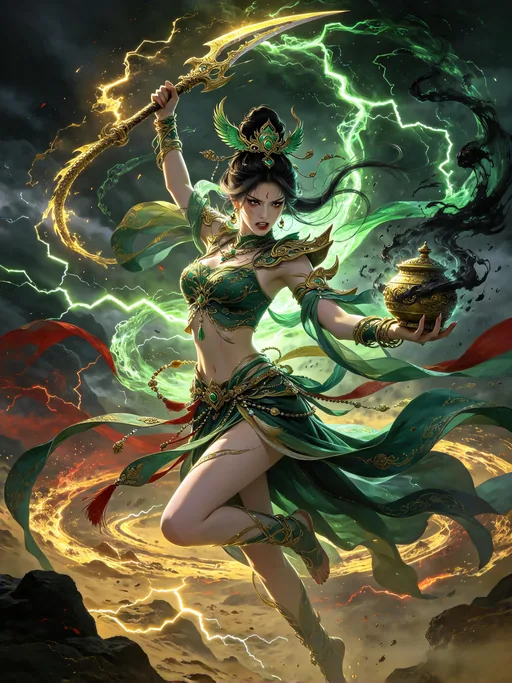
Bixiao Niangniang
IMMORTALS
碧霄娘娘
A beautiful maiden possessed by a thousand-year-old nine-tailed fox, sent by the goddess Nüwa to corrupt the Shang dynasty, only to be executed for her excessive cruelty.
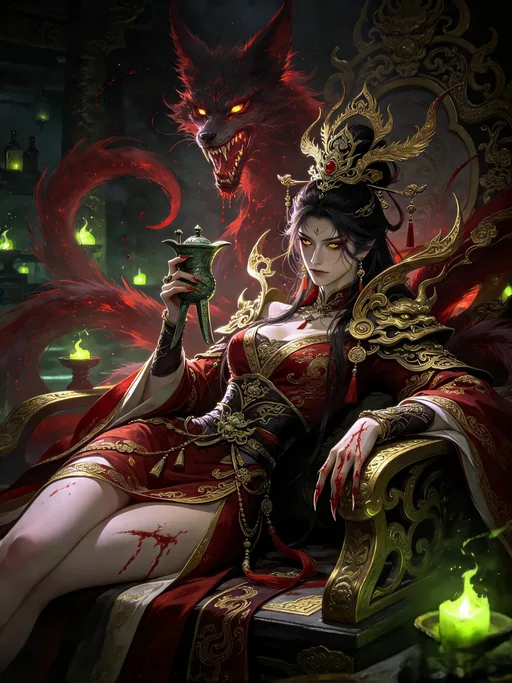
Da Ji
DEMONS
妲己
Deng Jiugong's daughter, a mortal general whose stones never miss a face. She wounded three Zhou champions and hit Kong Xuan three times when no immortal could touch him. Taken by a rope and married the same night to secure her father's defection, she fought for the Zhou until Gao Lanying blinded her with needles and cut her down. Enrolled as the Star of Six Harmonies.
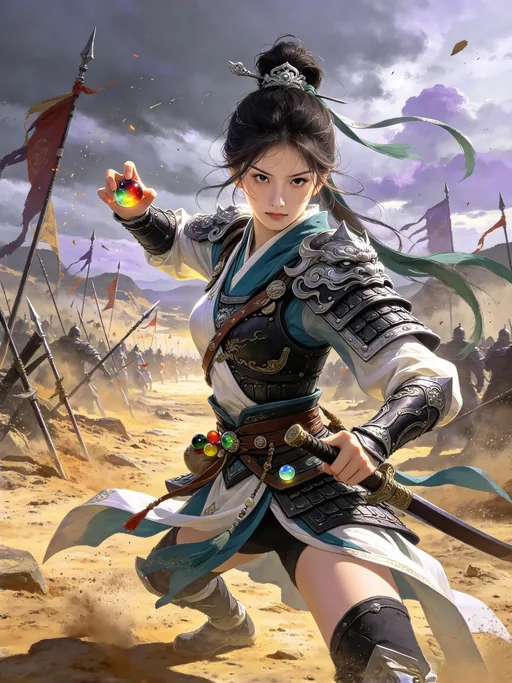
Deng Chanyu
MORTAL HEROES
邓婵玉
The powerful chief disciple of Tongtian Jiaozhu, whose arrogance sparked the final holy war, but whose defeat led to an unexpected apotheosis as the supreme Buddha of the West.

Duobao Daoren
IMMORTALS
多宝道人