Ji Chang
姬昌King Wen of Zhou · The Western Duke · Xi Bo Chang
King Wen of Zhou, the Civilizing King
The Western Duke of Shang who composed the sixty-four hexagrams in prison, endured the murder of his eldest son and the eating of his flesh, and returned to appoint Jiang Ziya as chief minister — laying the foundation of the Zhou without living to see it founded.
Sovereignty over the Zhou founding, the ordering of the hexagrams, and the virtue that draws men to a cause
A Vassal, Not a Rebel
Ji Chang is the Western Duke of the Shang, ruler of the Zhou territory under the king's suzerainty. The novel is careful to establish this before it establishes anything else: he inherits the western lordship from his father and rules for decades as a loyal, if increasingly uneasy, servant of the court. In the novel's arrangement he is one of the Four Great Lords — with Jiang Huanchu of the East, E Chongyu of the South and Chong Houhu of the North — and the eldest of them in virtue. The older histories tell it differently, making him one of three dukes alongside the Marquis of Jiu and the Marquis of E; the novel replaces that triad with its own quartet of border lords.
Its portrait begins with virtue rather than power. He is a ruler who accumulates goodness and piles up merit, who cares for the old and the young, who is so solicitous of worthy men that he will not eat his morning meal until he has received them. His authority is moral rather than military: the western lords follow him because he is just, and the able men of the realm gather at his court because he treats them well. That is exactly what makes the Shang nervous. When the court moves against him the charge is precise — he is accumulating goodness and the lords all turn toward him. In the novel's political logic, virtue is a form of power a tyrant cannot tolerate, and his imprisonment is not punishment for a crime but preventive detention of a man whose goodness has become a threat.
Four Nipples and a Tortoise Shell
The novel inherits an ancient physiognomic tradition for him and uses it sparingly. A passing line in the chapter of his departure notes, as though everyone knew it, that the Western Duke has four nipples on his chest, twenty-four consorts and ninety-nine sons. The four nipples are glossed in the tradition as a mark of supreme benevolence — a body with four sources of nourishment, a ruler whose care extends past the ordinary measure; the handbooks add a dragon face, tiger shoulders, and a height of ten feet.
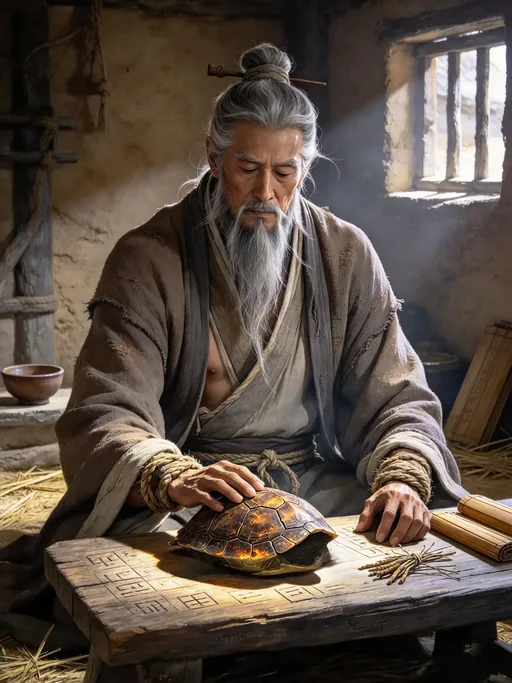
Otherwise his imagery is that of the sage-ruler rather than the warrior. He carries no axe and no halberd. His instruments are the tortoise shell and the yarrow stalks, and his most famous image in the novel is not on a battlefield but in a cell, bent over a diagram, tracing the lines of a cosmos he is the first to see whole. The other visual marker is the plainness of his captivity: the lord's robes reduced to a prisoner's coarse cloth, and a return that is not a triumph but a flight, a man on a horse with the taste of his son still in his mouth. His iconography is deliberately unglamorous — a good man broken by a system he tried to serve, and whose brokenness is the beginning of a new order.
Seven Years and Sixty-Four Hexagrams
The imprisonment at Youli lasts seven years, and the novel frames it not as an interruption of his life but as the condition of his most important work. In the cell, stripped of the duties of rule, he takes the eight trigrams Fuxi devised and doubles them one over another into sixty-four hexagrams, six lines each, three hundred and eighty-four in all. The formula later tradition fixes on the episode — that the king was imprisoned and therefore composed the Changes — is also its meaning.
What the novel emphasizes is not the technical achievement but its character. Ji Chang is a mortal. He has no supernatural teacher, no elixir, no treasure; his access to the order of the cosmos comes through patience and attention, through the discipline of sitting still and watching how things change. The hexagrams are a map of the way fortune moves, drawn by a man who had every reason to believe fortune had abandoned him. That is the whole of his power, and it is why he matters in a book full of immortals: he is the one figure whose strength is entirely a matter of attention.
The Pies
The seven years are also the novel's moral laboratory. His eldest son Bo Yikao comes to the capital to plead for his father's release, bearing treasures and beautiful women as tribute; Daji, offended by his refusal of her advances, arranges his death. King Zhou has him killed and his flesh made into meat pies, which are sent to the cell. The novel is explicit about the calculation: if Ji Chang eats, he proves he does not know what the meat is and can be released as harmless; if he refuses, he proves he knows and must die.
He eats, and the novel does not present this as weakness but as a calculation as cold as the one that produced the pies. He knows what the meat is. He eats because eating is the only way to live, and living is the only way to avenge his son and finish the work the hexagrams have shown him is possible. This is the exact point where virtue and necessity collide, and the novel refuses to soften it: the sage is not the man who would rather die than eat, but the man who eats and keeps the account.
The Horse and the Rabbits
His release is bought, not earned. His ministers search out beautiful women, fine horses and treasures and present them to King Zhou, who is pleased and lifts the detention. But the release is also a test: the novel sends him out of the capital under observation, to determine whether the man who ate his son's flesh is really the sage the rumours claim.
He rides out on the Xiaoyao horse, and at the last pass the calculation collapses. Ji Chang cries out in grief, falls from the saddle and vomits — and what comes out is not food but three rabbits, which run west toward Zhou. Folk tradition reads them as the three souls of Bo Yikao, transformed by a father's grief; the sage who had to eat his son is given his son back in the form of small fleeing animals, and they reach home before he does. It is the emotional centre of his story, and it is deliberately not a triumph. He does not escape as a hero. He escapes as a man who has paid a price no political victory can reimburse, and the later chapters never let him forget it.
The Wei River, and the Name After
His return to Zhou is not a return to the status quo. The Western Duke who went to the capital as a loyal vassal comes back as a ruler who understands that the Shang cannot be served, only replaced — and replacement requires a strategist he does not have. The search is the novel's most famous pastoral episode: he dreams of a flying bear, goes hunting on the banks of the Wei, and finds an old man fishing with a straight hook and no bait. The conversation that follows is not an interview but a recognition, and the appointment is immediate — no riddles and no trials; he takes the old man into his chariot and makes him chief minister on the spot. Folk tradition adds the cart pulled eight hundred steps and the eight hundred years promised in return; the novel omits the cart but keeps the gesture, which is the point of it.
That is his last great act. He dies of illness in his own bed before the eastern campaign begins, and he does not appear on the Fengshen roster at all — not a demotion, since the roster enrolls gods broken by the war and needing an office to steady them, and he was broken in another way. He leaves the cause to his son Ji Fa, the strategist to his son's service, and the mandate, still unproven, to the war that will prove it. Later tradition remembers him as King Wen, the Civilizing King: his posthumous name means culture and pattern, against his son's Wu, the martial. The Zhou was founded by a man of culture and completed by a man of war, and the man of culture came first. He is not a saint because he never did anything terrible; he is a sage because he did something terrible, survived it, and built anyway.
More from this collection
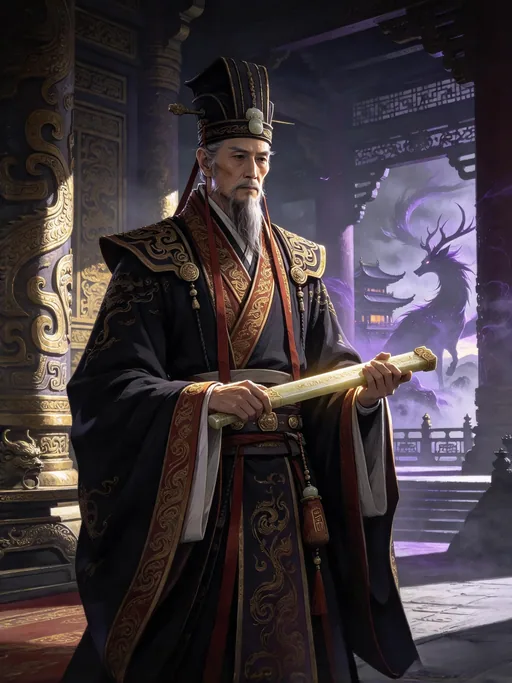
A Shang grand counselor and royal uncle of King Zhou, killed on Daji's demand for his seven-orifice heart. His death became one of the dynasty's defining crimes, and he was apotheosized as the Lord of the Wenqu Star.
Bi Gan
MORTAL HEROES
比干
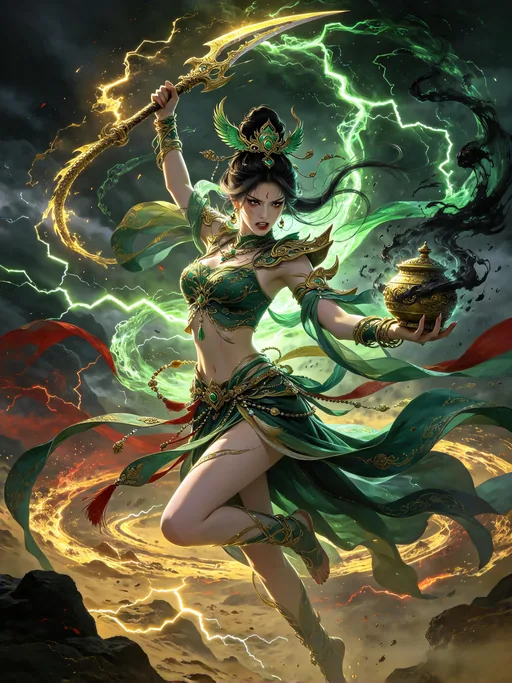
The youngest of the Sanxiao Sisters, a fiercely devoted and impulsive immortal who helped unleash the Nine-Meander Yellow River Formation, only to meet a tragic end at the hands of the supreme saints.
Bixiao Niangniang
IMMORTALS
碧霄娘娘
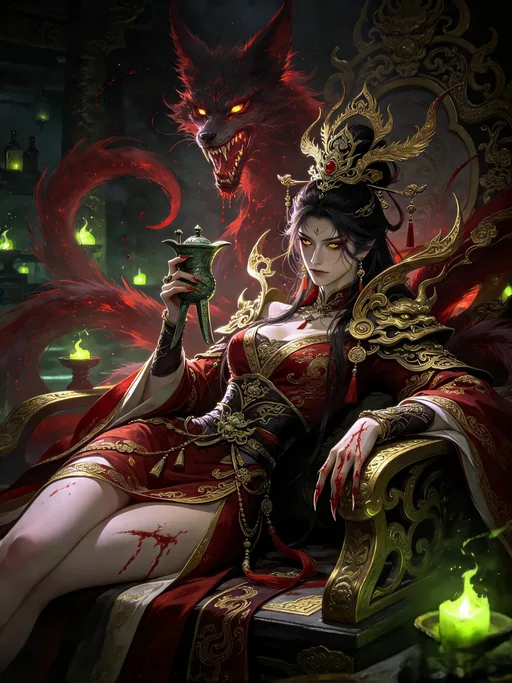
A beautiful maiden possessed by a thousand-year-old nine-tailed fox, sent by the goddess Nüwa to corrupt the Shang dynasty, only to be executed for her excessive cruelty.
Da Ji
DEMONS
妲己
Deng Jiugong's daughter, a mortal general whose stones never miss a face. She wounded three Zhou champions and hit Kong Xuan three times when no immortal could touch him. Taken by a rope and married the same night to secure her father's defection, she fought for the Zhou until Gao Lanying blinded her with needles and cut her down. Enrolled as the Star of Six Harmonies.
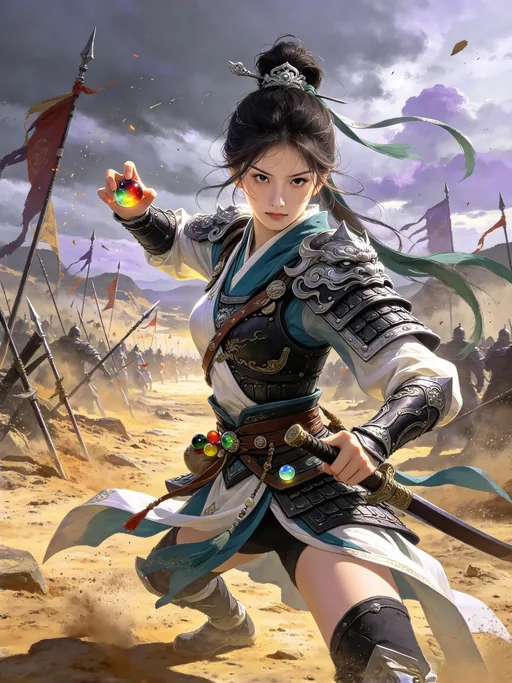
Deng Chanyu
MORTAL HEROES
邓婵玉