Nüwa
女娲The Mother Goddess · Empress Nüwa
The Holy Mother Who Mends the Heavens
The primordial creator goddess who molded humanity from clay and mended the broken sky, whose brief moment of anger set the entire Investiture of the Gods into motion.
Creation, Fate, and the Protection of Humanity
Identity and Origins
Nüwa is one of the oldest and most revered deities in Chinese mythology. She is the creator of humanity, having molded the first humans from yellow clay, and the savior of the world, who melted five-colored stones to patch the sky after a great cataclysm.
In the context of the Investiture of the Gods, Nüwa is the catalyst for the entire war. She is a primordial saint (a status equal to or even higher than the Three Pure Ones), residing in the Wa Palace in the celestial realm. Though she rarely interferes in mortal affairs, her divine authority is absolute.
Appearance and Iconography
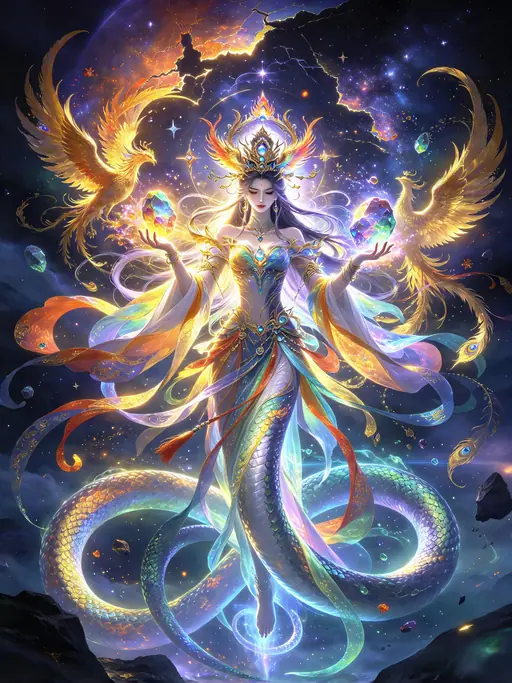
Nüwa is depicted in two forms. In her humanized, divine form, she is a breathtakingly beautiful and majestic goddess, wearing resplendent robes of gold and iridescent silks that shimmer with the colors of the five-colored stones.
In her true primordial form, she is often depicted with a human upper body and the lower body of a divine serpent (Naga-like), symbolizing her ancient, pre-human origins. She commands the Golden Phoenix and holds the power to create life or wipe it out with a mere thought. Her most sacred relics are the Five-Colored Stones she used to mend the heavens.
The Catalyst of the Investiture
On her birthday, King Zhou of Shang visited the Wa Palace to offer incense. Overwhelmed by her divine beauty, the arrogant king wrote a blasphemous poem on the wall, demanding that the goddess come to his palace and serve him.
Nüwa was furious. However, as she approached the capital to destroy the Shang dynasty, she saw that King Zhou still had 28 years of imperial destiny left, and killing him directly would violate the will of heaven. Instead, she summoned the three demon spirits from the Xuanyuan Tomb (a thousand-year-old fox, a nine-headed pheasant, and a jade pipa spirit) and commanded them to corrupt the king's mind and hasten the dynasty's collapse.
The Betrayal of Da Ji
After the war, when Da Ji was captured by the Zhou army, she pleaded with Nüwa to save her, reminding the goddess that she was only following divine orders.
Nüwa coldly disowned her. She argued that she had ordered the fox demon to corrupt the king, but not to commit atrocities like the Paolao torture or eating the hearts of loyal ministers. Because Da Ji's cruelty had exceeded the bounds of divine mandate, Nüwa abandoned her, allowing Jiang Ziya to execute her.
Fate and Divine Role
Nüwa did not participate in the subsequent battles between the Chan and Jie factions. She remained above the conflict, a supreme deity watching the cosmic order reset.
As the goddess of creation and marriage, she is revered throughout China. Her role in the Investiture demonstrates the terrifying power of the gods: she can create an entire species, save the world, and destroy an empire with a single decree.
Cultural Legacy
Nüwa is a foundational figure in Chinese culture, symbolizing maternal love, resilience (mending the sky), and absolute sovereignty.
In modern fantasy, she represents the peak of divine power—a figure who is both a loving mother to humanity and a terrifying force of nature to those who disrespect her. The story of her punishing King Zhou is a classic warning against the sin of hubris.
More from this collection
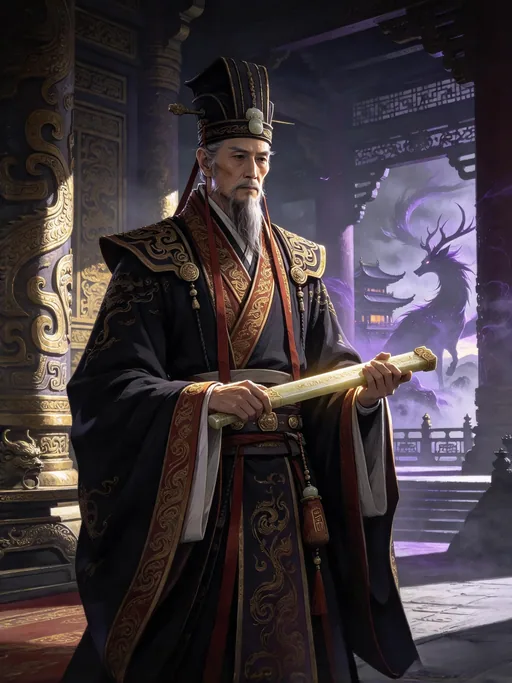
A Shang grand counselor and royal uncle of King Zhou, killed on Daji's demand for his seven-orifice heart. His death became one of the dynasty's defining crimes, and he was apotheosized as the Lord of the Wenqu Star.
Bi Gan
MORTAL HEROES
比干
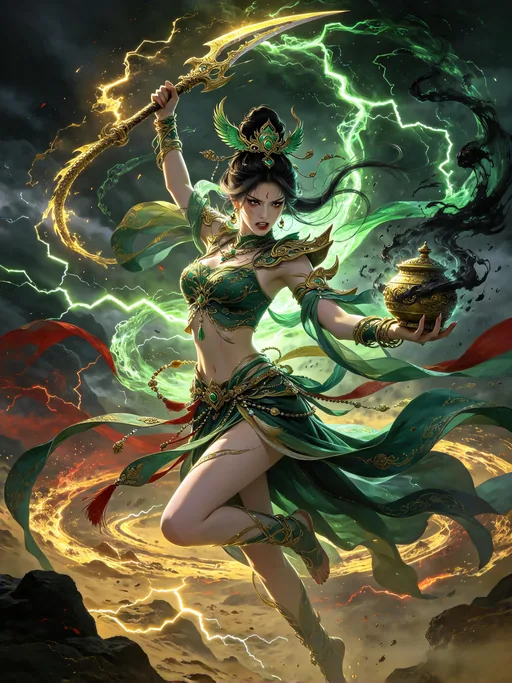
The youngest of the Sanxiao Sisters, a fiercely devoted and impulsive immortal who helped unleash the Nine-Meander Yellow River Formation, only to meet a tragic end at the hands of the supreme saints.
Bixiao Niangniang
IMMORTALS
碧霄娘娘
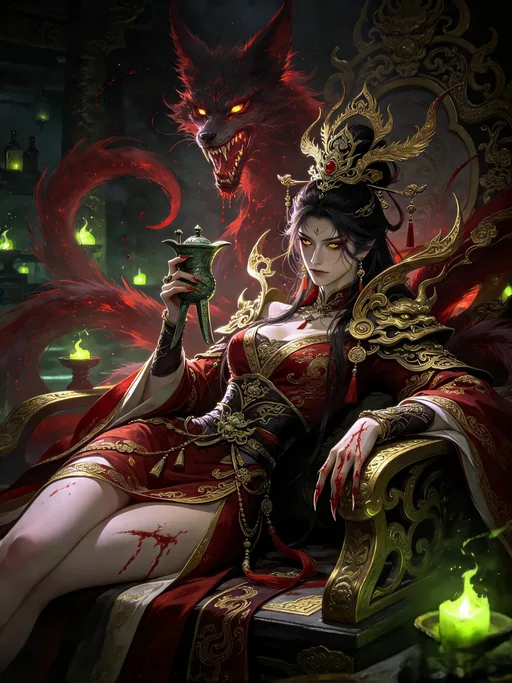
A beautiful maiden possessed by a thousand-year-old nine-tailed fox, sent by the goddess Nüwa to corrupt the Shang dynasty, only to be executed for her excessive cruelty.
Da Ji
DEMONS
妲己
Deng Jiugong's daughter, a mortal general whose stones never miss a face. She wounded three Zhou champions and hit Kong Xuan three times when no immortal could touch him. Taken by a rope and married the same night to secure her father's defection, she fought for the Zhou until Gao Lanying blinded her with needles and cut her down. Enrolled as the Star of Six Harmonies.
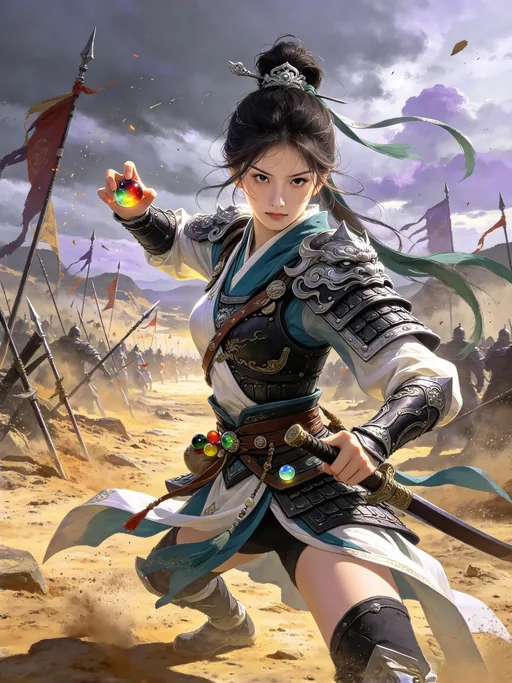
Deng Chanyu
MORTAL HEROES
邓婵玉