Sun Wukong
孙悟空The Monkey King · Qitian Dasheng (Great Sage Equal to Heaven) · Meihou Wang (Handsome Monkey King) · Douzhan Shengfo (Victorious Fighting Buddha)
The Great Sage Equal to Heaven, later the Victorious Fighting Buddha
A monkey born from a stone on Mount Huaguo, who learned the arts of immortality, seized the Dragon King's staff, erased his name from the registers of death, and declared himself Great Sage Equal to Heaven — before being pinned under Mount Five Elements and later becoming the protector of the Tang monk's pilgrimage.
Mastery of transformation, cloud-travel, and the staff; the patron of the defiant and the ungovernable
Identity and Origins
Sun Wukong is not a character in the Fengshen Yanyi. He belongs to the Journey to the West, composed several centuries after the Investiture narrative took its present form. This entry exists because this collection is not sealed off from the rest of Chinese myth: Nezha, Yang Jian and Li Jing appear in both texts, and the relation between a war of investiture and a pilgrimage is one of the most productive cross-textual connections in Chinese literature. Wukong is the most important figure on the Journey to the West side of it.
His origin is the most famous in Chinese myth. On the summit of Mount Huaguo, a stone that had absorbed the essence of heaven and earth since the beginning of the world split open and a stone monkey emerged. He had no parents; he was born of geology and time. The novel treats both the stone's formation and the monkey's birth as cosmic events, visible from the celestial court.
This origin matters for the same reason Shiji Niangniang's does: it places him outside the ordinary hierarchies. He has no sect, no teacher at birth, no lineage. He acquires a teacher later — the Patriarch Subhuti — but that teacher makes him swear never to reveal who taught him. He is, from the beginning, a being who belongs to no institution, and that is the source of both his power and his trouble.
Appearance and Iconography
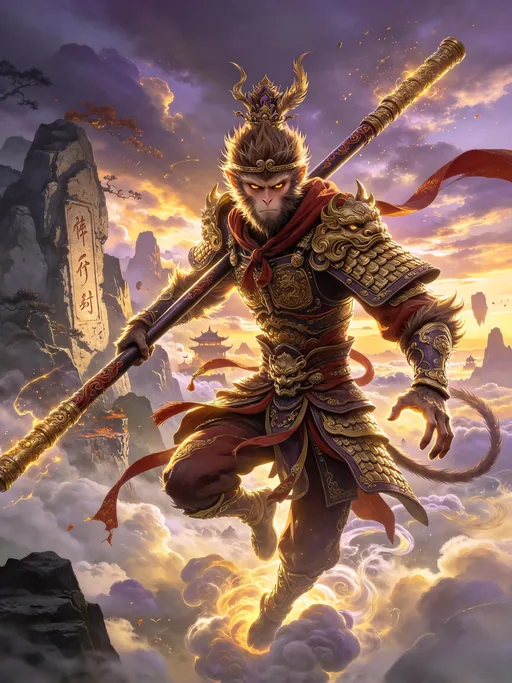
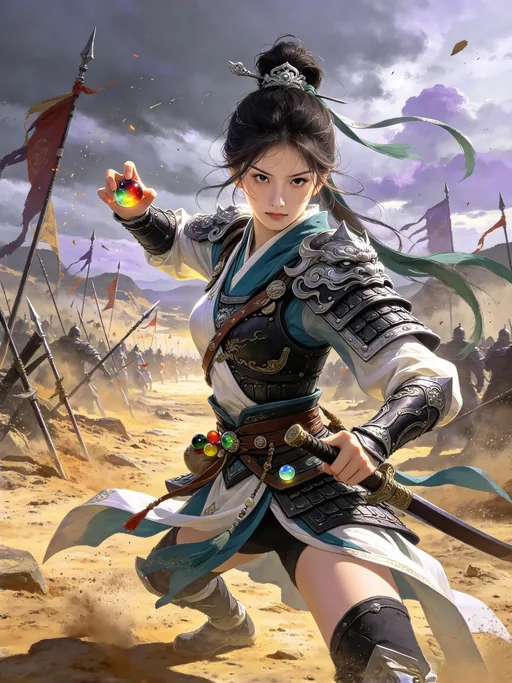
Sun Wukong's iconography is among the most recognizable in world literature. He is a monkey, described as a stone monkey with a face like a thunder god's, eyes that flash with golden light, and a body covered in coarse hair. In full martial regalia he wears the phoenix-feather cap, the golden chainmail and cloud-walking boots, and he carries the Ruyi Jingu Bang — the golden-hooped staff he seized from the Dragon King of the Eastern Sea.
The staff is the key object. It was originally the pillar that measured the depths of the sea, a piece of cosmic infrastructure. It weighs 13,500 catties, can shrink to the size of a needle or grow to pierce the sky, and obeys its owner's command. When Wukong takes it, he is not merely arming himself; he is taking a piece of the world's structure and making it personal.
His other attributes are the seventy-two transformations and the cloud-somersault, a leap of 108,000 li, which together make him the most mobile and unpredictable fighter in Chinese myth: not a warrior who holds a line, but one who appears where he is not expected, in a shape no one expects. The golden fillet on his brow is the counter-image — the one object he cannot remove and the one thing that binds him. When the Tang monk recites the tightening spell it constricts and brings him to his knees. The novel's visual argument is that the Monkey King is defined by both: the staff that obeys him and the fillet that does not.
Havoc in Heaven
Sun Wukong's defining episode is the sequence that Chinese tradition calls “Havoc in Heaven” (大闹天宫). It begins with his acquisition of power and his refusal to accept a subordinate place in the cosmic order. He seizes the Dragon King's staff, erases his name and the names of his monkeys from the registers of death, and accepts the celestial court's offer of the post of Bimawen (弼马温), the keeper of the heavenly horses — only to discover that the post is the lowest rank in the celestial bureaucracy, and to revolt.
The revolt is not a war of conquest. It is a refusal of hierarchy. Wukong declares himself Qitian Dasheng — Great Sage Equal to Heaven — and builds a banner with those words. He defeats the celestial armies sent against him, including the forces led by Li Jing and Nezha. The novel's account of the Nezha fight is brief and pointed: the two of them fight with transformations, and Wukong wins by plucking a hair to make a double of himself that distracts Nezha while the real Wukong strikes from behind.
The havoc ends only when the Buddha intervenes. The Buddha wagers that Wukong cannot leap out of his palm. Wukong somersaults to the edge of the universe, marks a pillar with his name, and returns — only to find that the pillar was the Buddha's finger. The Buddha turns his hand over and pins Wukong beneath Mount Five Elements (五行山), where he remains for five hundred years.
The Journey to the West
The second half of Sun Wukong's career is the pilgrimage. Released from Mount Five Elements by the monk Xuanzang (Tang Sanzang), he becomes the monk's chief disciple and protector, bound by the golden fillet and by a promise to see the monk safely to the Western Paradise. The journey is the novel's main narrative, and Wukong's role in it is that of the enforcer: when a demon blocks the road, Wukong fights it; when the monk is captured, Wukong rescues him; when the monk is foolish, Wukong argues with him and is punished by the fillet.
This section of his story is where the cross-textual connection becomes most visible. Nezha appears as the celestial general who fought him during the Havoc in Heaven and who later, on the road west, fights beside him — most memorably against the Bull Demon King. Yang Jian appears as Erlang Shen, the heavenly-eyed god who is one of the few figures Wukong ever meets as an equal, and who catches him in the end at the wager of transformations. Li Jing appears as the pagoda-bearing commander of the celestial armies. The Investiture's gods have become the Journey's celestial bureaucracy, and Wukong is the being who forces that bureaucracy to reveal its limits.
Fate and Apotheosis
Sun Wukong does not appear on the Fengshen roster, because he does not belong to the Investiture's chronology. He is born, by the novel's internal dating, long after the Shang-Zhou war. His “apotheosis” is of a different kind: not enrollment among the 365 gods, but Buddhahood. At the end of the Journey to the West, he is confirmed as the Victorious Fighting Buddha, and the golden fillet that bound him falls away on its own.
The contrast with the Fengshen system is instructive. In the Investiture, gods are made by death and judgment: a being is killed, judged, and assigned an office. In the Journey, enlightenment is achieved through practice and ordeal: a being is tested across eighty-one calamities and confirmed in his new status. The two systems are not the same, and this collection treats them as adjacent rather than identical. Sun Wukong is the figure through whom the difference becomes visible.
Cultural Legacy
Sun Wukong's cultural legacy is, by any measure, the largest of any figure in this collection. He is the protagonist of the most translated Chinese novel in the world, the subject of countless operas, films, television series, comics, and video games, and the closest thing Chinese popular culture has to a universal hero. The 1961 animated film Havoc in Heaven, the 1986 television series, and the 2015 film Monkey King: Hero Is Back are only the most visible nodes in a continuous tradition of adaptation.
His importance to this collection is different. He is the figure who makes the cross-textual dimension of the project legible. A reader who comes to the Investiture material through Nezha or Yang Jian will meet Sun Wukong as the being those gods fought and later served alongside. A reader who comes through Sun Wukong will meet the Fengshen gods as the celestial bureaucracy that Wukong spent his early career defying. Either way, the collection is not a list of isolated entries. It is a network, and Sun Wukong is one of its most important nodes.
For English-language readers, he is also the entry point. More English-language readers know Sun Wukong than know any other figure in this collection, and his presence here is a deliberate invitation: if you know the Monkey King, you already know something about the world these other figures inhabit.
More from this collection
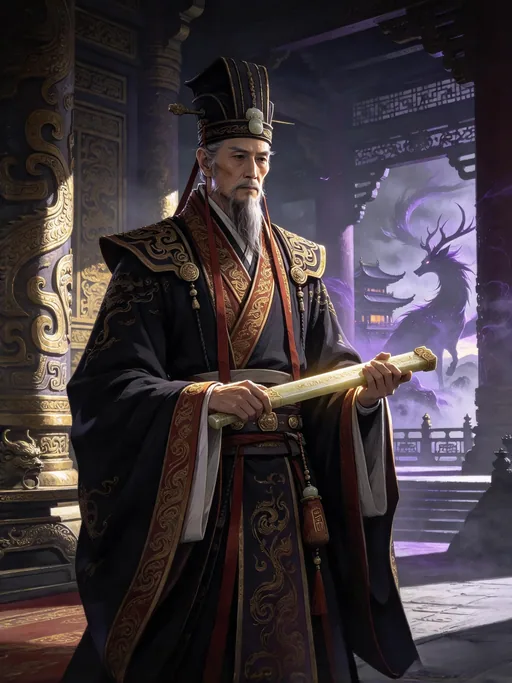
A Shang grand counselor and royal uncle of King Zhou, killed on Daji's demand for his seven-orifice heart. His death became one of the dynasty's defining crimes, and he was apotheosized as the Lord of the Wenqu Star.
Bi Gan
MORTAL HEROES
比干
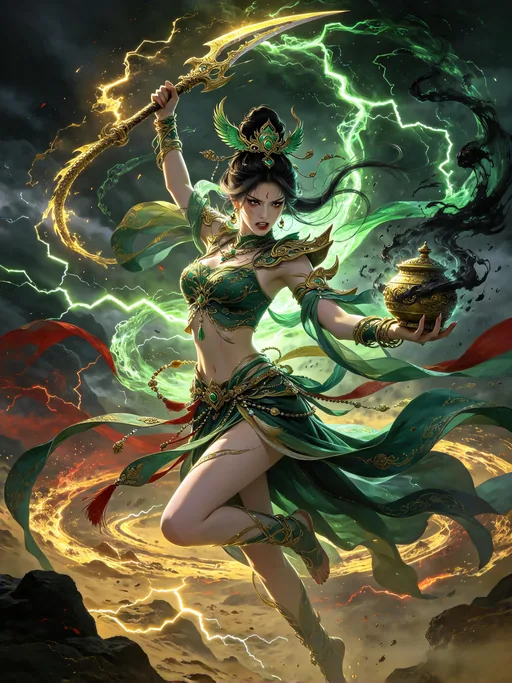
The youngest of the Sanxiao Sisters, a fiercely devoted and impulsive immortal who helped unleash the Nine-Meander Yellow River Formation, only to meet a tragic end at the hands of the supreme saints.
Bixiao Niangniang
IMMORTALS
碧霄娘娘
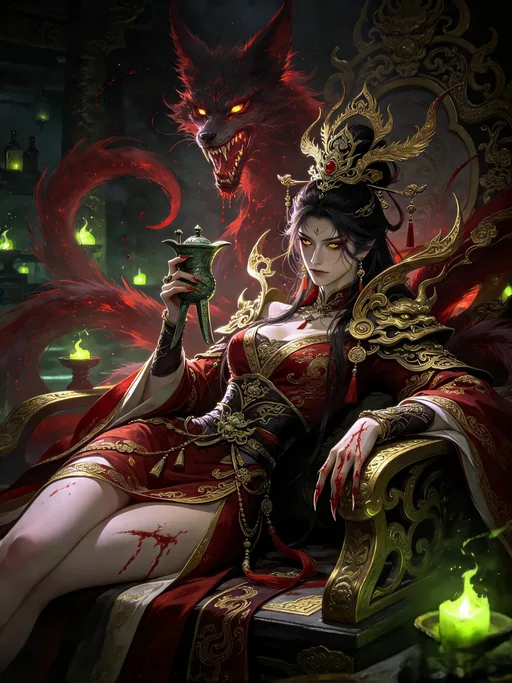
A beautiful maiden possessed by a thousand-year-old nine-tailed fox, sent by the goddess Nüwa to corrupt the Shang dynasty, only to be executed for her excessive cruelty.
Da Ji
DEMONS
妲己
Deng Jiugong's daughter, a mortal general whose stones never miss a face. She wounded three Zhou champions and hit Kong Xuan three times when no immortal could touch him. Taken by a rope and married the same night to secure her father's defection, she fought for the Zhou until Gao Lanying blinded her with needles and cut her down. Enrolled as the Star of Six Harmonies.
Deng Chanyu
MORTAL HEROES
邓婵玉