Gao Jineng
高继能The Wasp-Bag General of Golden Rooster Ridge
Five-Army Rescue Officer under Kong Xuan, the Black-Slaughter Star
A Shang officer under Kong Xuan at Golden Rooster Ridge, who used a bag of poisonous wasps to blind Huang Tianhua's Jade Qilin and then speared the dismounted vanguard to death — a small, nasty victory that cost him his own life when the Five Peaks came for him, and that earned him the office of the Black-Slaughter Star.
Defense of a mountain pass and the deployment of swarming insects in battle
Identity and Origins
Gao Jineng is an officer under Kong Xuan, the peacock demon who commands the San Shan Pass garrison and holds Golden Rooster Ridge against the Zhou army. His specific post is that of Five-Army Rescue Officer (五军救应使) — a staff officer whose job is to plug gaps, hold outer approaches, and take whatever station his commander assigns on a given night. The novel introduces him in Chapter 69, at a point in the eastern campaign when the Zhou advance has become a grinding sequence of pass-by-pass fights.
He is not a major figure in the cosmic war between the Chan and Jie teachings. He is a mortal commander with a specific talent, and his importance in the narrative is concentrated almost entirely in a single engagement. His position is that of a gatekeeper. Golden Rooster Ridge is a mountain pass, and Gao Jineng's job is to hold it. He does not seek out the Zhou commanders; they come to him, and he meets them with the tools his position provides. The novel does not give him a backstory, a teacher, or a personal grievance.
This ordinariness is the point. The Fengshen Yanyi is full of immortals with cosmic powers, and it is easy to forget that most of the war is fought by people who are not immortals at all. Gao Jineng is one of those people. His one great achievement is not a feat of cultivation. It is the correct use of a small, nasty weapon at the correct moment.
Appearance and Iconography
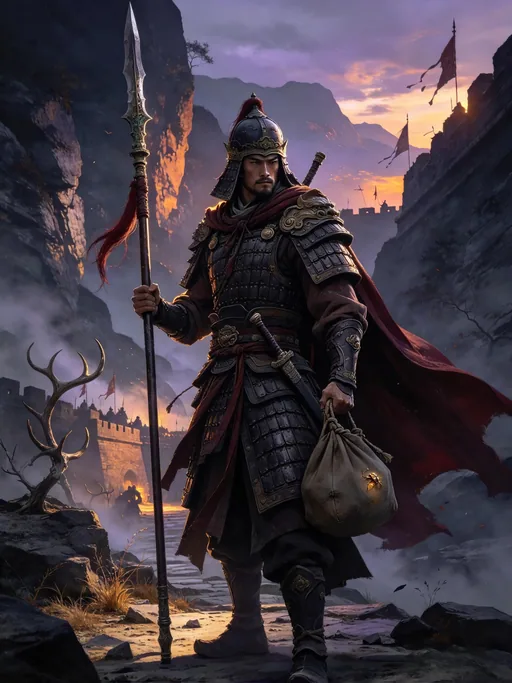
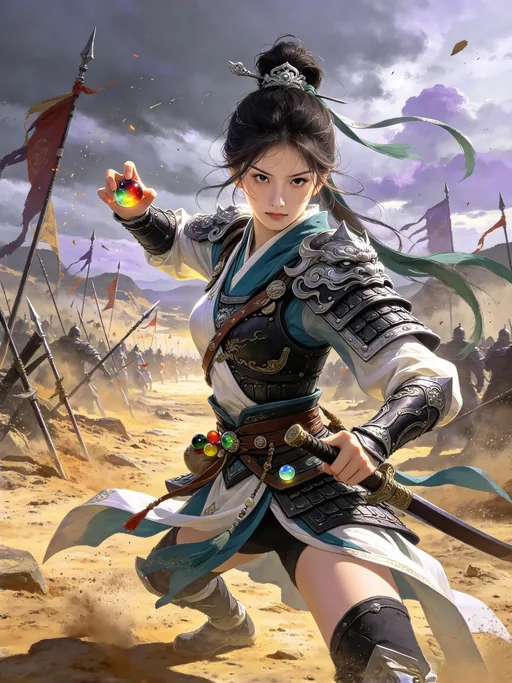
The novel gives Gao Jineng the standard appearance of a Shang field officer: a hardened man wearing the layered armor of a Shang commander — dark iron plates over padded cloth, bronze fittings at the shoulders and waist, a dark red cloak. He carries a steel spear (钢枪), a practical weapon for a man who fights from horseback and expects to hold a line rather than duel an immortal.
His distinctive object is the wasp bag (蜈蜂袋), a pouch that holds a swarm of poisonous wasps. The bag is not a treasure in the usual sense. It has no cosmic origin, no immortal maker, no elaborate ritual. It is a container, and its power is entirely in what it contains. When released, the wasps come on in clouds, "heaped and massed like a plague of locusts," and the novel is specific about their effect: they go for the eyes — most fatally, the eyes of the victim's mount.
This is the whole of his iconography, and it is deliberately unglamorous. Where other characters carry banners that summon wind or pearls that shake the sea, Gao Jineng carries a bag of insects. The novel's design choice is to make him visually unremarkable and tactically decisive — a man whose silhouette gives no warning of what he can do.
The Killing of Huang Tianhua
Gao Jineng's defining episode is the death of Huang Tianhua at Golden Rooster Ridge, and the novel stages it as a night fight inside a broken camp rather than as a formal duel. Kong Xuan has foreseen Jiang Ziya's raid and posts his officers in ambush: Gao Jineng at the left gate, Zhou Xin at the right. Huang Tianhua, hearing the alarm, charges into the left camp on his Jade Qilin without waiting to learn what he is riding into.
The fight itself is one-sided in Huang Tianhua's favor. His twin silver hammers come down "like falling stars"; Gao Jineng cannot hold him, feints with the spear, and turns his horse to run. Huang Tianhua pursues — and that is the mistake. Gao Jineng opens the wasp bag. The swarm rises in the dark, Huang Tianhua beats at it with his hammers, and a wasp stings the Jade Qilin in the eye. The beast screams, rears onto its hind legs, and throws its rider. Huang Tianhua hits the ground, and Gao Jineng's spear takes him under the ribs. He dies on the spot, and his soul goes to the Investiture Terrace.
The novel frames this as the fulfillment of a warning. Before the campaign, Huang Tianhua's master Qingxu Daode Zhenjun had told him to beware an enemy named for height and ability, and to fear the golden rooster and the wasp. The novel places the warning in the reader's hands and then lets the campaign unfold toward it. Gao Jineng wins because he uses a weapon that attacks the mount rather than the rider, and because Huang Tianhua rides into exactly the place where every condition of the warning was satisfied. The victory is small, nasty, and complete.
The Five Peaks and the Iron-Beaked Eagles
The sequel is where Gao Jineng's story turns. Huang Feihu, mad with grief for his son, does not attack alone. He calls in four lords — Chong Heihu, Wen Pin, Cui Ying, and Jiang Xiong — and the five of them ride out together. This is the first time the Five Peaks take the field as a unit, and they take it against the man who killed Huang Tianhua.
Gao Jineng fights them all at once and holds them for a long while — one spear against five weapons, unable to break out of the circle. When the pressure becomes unbearable he spurs clear and opens the wasp bag again. The swarm rises, blotting the sky. And then Chong Heihu uncovers the red gourd at his back, and black smoke pours out of it, and out of the smoke come a thousand iron-beaked divine eagles. The eagles take the wasps the way a flock takes a swarm of locusts. The bag is empty of its power.
Gao Jineng, enraged, charges back into the five of them. He cannot win that fight either. Huang Feihu's spear takes him under the ribs, as his had taken Huang Tianhua; he falls from the horse and his head is taken.
Fate and Apotheosis
Gao Jineng dies at Golden Rooster Ridge, and unlike most of the novel's minor mortal officers, he does enter the roster. At the investiture he is named the Black-Slaughter Star (黑杀星) — one of the Dipper's host of stars, an office that governs violent death and the killing of the unworthy. It is a modest post compared with the great offices of the war, but it is a post, and it is his.
The novel's arrangement here is exact, and it is worth noticing how it rhymes. Gao Jineng kills a Zhou vanguard by striking his horse; he dies by a spear under the ribs, delivered by that vanguard's father. His wasp bag is broken not by cultivation but by another man's gourd of eagles. The chain of small, ugly means runs all the way through: a bag of insects kills a future god, a gourd of birds kills the bag, and a mortal officer's spear kills the man who owned the gourd's counter.
The Black-Slaughter Star is, in the end, an accurate label. Gao Jineng spent his one great day doing exactly what that office describes: killing, by a means that no one would call honorable, a young man who should have lived to become a god.
Cultural Legacy
Gao Jineng's cultural legacy is minimal. He has no cult, no temple tradition, and no independent myth cycle. He appears in adaptations of the Fengshen Yanyi as a minor antagonist, usually in the single episode of Huang Tianhua's death, and he is remembered, when he is remembered at all, as the man with the wasp bag.
His value to the project is different. He is a useful example of a narrative type that the Fengshen Yanyi uses repeatedly: the minor officer whose one correct decision has permanent consequences. The novel is full of immortals whose powers are cosmic and whose defeats are dramatic. Gao Jineng is the opposite. His power is small, his victory is nasty, and his consequence is permanent. Huang Tianhua does not die in a clash of cosmic forces. He dies because a horse was blinded by insects.
He also belongs to a small pattern worth noticing across the eastern campaign: the passes of the late war are held not by immortals but by professionals — Zhang Kui at Mianchi with his earth-travel, Gao Jineng at Golden Rooster Ridge with his wasps — and each of them costs the Zhou side a name it cannot get back. The novel's willingness to give such figures decisive roles is one of the things that makes its world feel like a war rather than a tournament.
More from this collection
A Shang grand counselor and royal uncle of King Zhou, killed on Daji's demand for his seven-orifice heart. His death became one of the dynasty's defining crimes, and he was apotheosized as the Lord of the Wenqu Star.
Bi Gan
MORTAL HEROES
比干
The youngest of the Sanxiao Sisters, a fiercely devoted and impulsive immortal who helped unleash the Nine-Meander Yellow River Formation, only to meet a tragic end at the hands of the supreme saints.
Bixiao Niangniang
IMMORTALS
碧霄娘娘
A beautiful maiden possessed by a thousand-year-old nine-tailed fox, sent by the goddess Nüwa to corrupt the Shang dynasty, only to be executed for her excessive cruelty.
Da Ji
DEMONS
妲己
Deng Jiugong's daughter, a mortal general whose stones never miss a face. She wounded three Zhou champions and hit Kong Xuan three times when no immortal could touch him. Taken by a rope and married the same night to secure her father's defection, she fought for the Zhou until Gao Lanying blinded her with needles and cut her down. Enrolled as the Star of Six Harmonies.
Deng Chanyu
MORTAL HEROES
邓婵玉