Huang Tianhua
黄天化Bingling Gong · Lord of the Three Mountains
Bingling Gong, Administrator of the Three Mountains
Huang Feihu's eldest son, taken as a child by the immortal Qingxu Daode Zhenjun, who descended the mountain as a vanguard of Zhou, wielded the Heart-Piercing Nails against the Four Heavenly Kings, and was apotheosized as Bingling Gong, Lord of the Three Mountains.
Sovereignty over the three sacred mountains and the registers of mountain spirits
Identity and Origins
Huang Tianhua is the eldest son of Huang Feihu, the Martial King of Shang, and his wife Lady Jia. His story begins not with his father but without him. At the age of three, while playing in the family garden, he is carried away by the immortal Qingxu Daode Zhenjun of Green Peak Mountain. Huang Feihu does not know where the child has gone. For thirteen years, the heir of the Huang household grows up in a Daoist cave, learning the arts of an immortal while his family believes him lost.
When he descends the mountain at sixteen, the reunion is the first thing the novel asks the reader to feel. Huang Feihu has been struck down by the Shang general Chen Tong at Tong Pass, and Huang Tianhua arrives to save him. The father does not recognize the young Daoist who revives him. It is the son who kneels and says: I am the child who disappeared from the garden thirteen years ago. This asymmetry — the father who lost a son, the son who was never told he had a father waiting — defines Huang Tianhua's emotional architecture. He is a filial figure, but his filiality is not inherited. It is discovered, and it is late.
His personality is described in the novel with a single phrase repeated across chapters: his nature is like fire. He is impulsive, quick to anger, quick to grief, and quick to act. That temper will matter both in his victories and in his death.
Appearance and Iconography
Huang Tianhua's first appearance is deliberately unpolished: nine feet tall, complexion like mutton fat, eyes that stare too directly, a gait the novel calls "tiger-shaped and leopard-paced," hair tied in a topknot, a hemp sash at the waist, straw sandals on his feet. He looks less like a general than like a young ascetic who has walked a long way down a mountain.
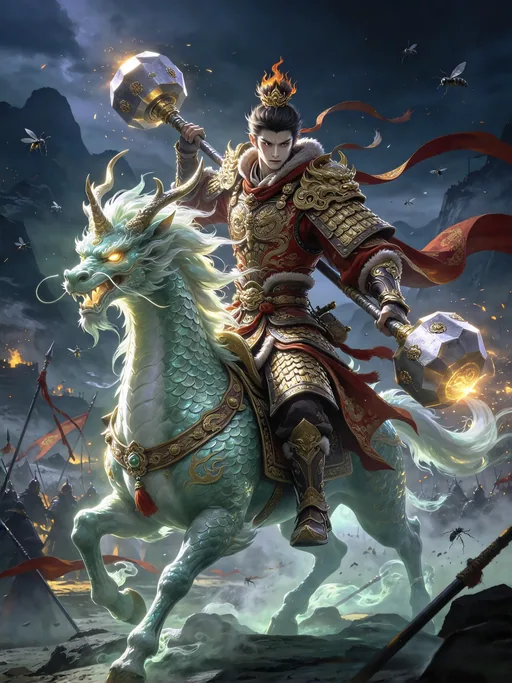
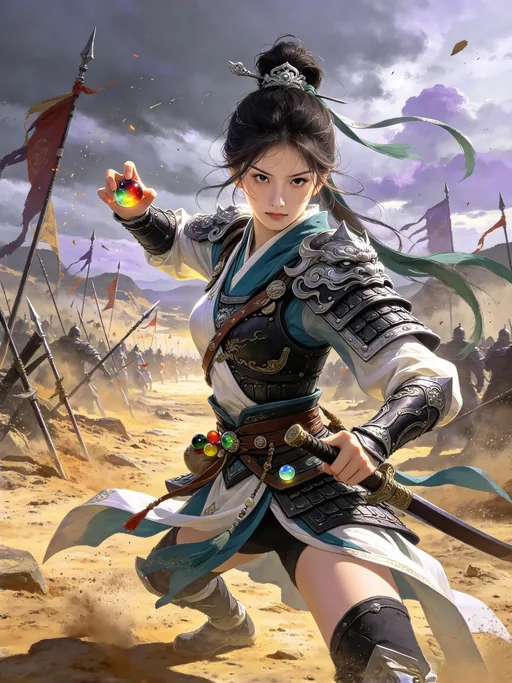
The image changes when he enters battle. Before facing the Four Heavenly Kings, he is described in full armor: a golden crown with flame motifs, a great red robe embroidered with coiled dragons, linked golden scale armor, and in his hands a pair of eight-edged silver hammers. His mount is the Jade Qilin, a beast whose horn, when tapped, summons wind and cloud. The qilin is not merely transportation; it is a sign that he rides as a moral being, since the novel notes that only those of genuine cultivation can sit it.
The visual contrast between the barefoot ascetic and the golden-armored vanguard is the point. Huang Tianhua carries both identities at once, and the novel never fully resolves which one he is. His treasures — the Heart-Piercing Nails, the Fire-Dragon Dart, the Mo Xie Sword, the flower basket that catches enemy weapons — are instruments of a Daoist initiate, but they are used in the service of a dynastic war.
Tong Pass and the Four Heavenly Kings
Huang Tianhua's first act as a descending warrior is to save the father he has never known. At Tong Pass, Chen Tong has struck Huang Feihu down with the Fire-Dragon Dart. Huang Tianhua arrives, catches the dart in his flower basket, kills Chen Tong with the Mo Xie Sword, and revives his father with elixir. The reunion scene that follows is brief but is the emotional center of his early arc: the son who was lost returns not as a child but as a rescuer.
His second and greater test comes against the Four Heavenly Kings — Mo Liqing, Mo Lihong, Mo Lihai, and Mo Lishou — who wield a sword, an umbrella, a pipa, and a serpent, and who have been devastating the Zhou camp. Huang Tianhua fights Mo Liqing and is defeated, because, as the novel explicitly states, he has broken his vows: he has eaten meat and shed his Daoist robes for a general's armor, and these two acts have shortened his allotted lifespan. His master revives him with elixir and gives him the Heart-Piercing Nails. With the nails, he kills all four kings in a single engagement.
This sequence establishes the template of his career: he wins, but he wins after a defeat that is also a moral warning. His victories are real, but they are always shadowed by the suggestion that he has already spent something he cannot recover.
The Zhou Vanguard
After the Four Heavenly Kings, Huang Tianhua becomes one of Zhou's standing commanders. When Jiang Ziya formalizes the army's structure, Huang Tianhua is named one of the four vanguards, alongside Nezha, Nangong Kuo, and Wu Ji. The appointment is significant: he is not a guest immortal who appears for a single battle, like many of the Chan disciples, but a permanent fixture of the Zhou military machine.
His record across the eastern campaign is extensive. He fights in the campaigns against Deng Chanyu, against Tu Xingsun, against the plague deities under Lü Yue, and against the various Jie faction immortals who descend on the Zhou lines. The novel is consistent about his pattern: he is brave to the point of recklessness, he wins more often than he loses, and he is repeatedly incapacitated not by superior skill but by unfamiliar magic — the Soul-Falling Bell, the Yin-Yang Mirror, the Eye-Piercing Pearl, plague, the Immortal-Binding Rope. He is a conventional warrior in a war that keeps producing unconventional weapons, and his body is the record of that mismatch.
His relationship with Nezha is one of the novel's small comedies. The two young hotheads argue after both are humiliated in battle, and their quarrels read as the friction of two people who are too alike to be comfortable with each other. Both are vanguards, both are young, both are impulsive, and both will die in ways that their masters warned them about.
Death at Golden Rooster Ridge and Apotheosis
Before the eastern campaign begins, Qingxu Daode Zhenjun gives Huang Tianhua a warning that is also a sentence: he must not fight officers whose names carry the sounds gao or neng, and he must avoid golden roosters and wasps. The novel does not explain why. It puts the prophecy in the reader's hands and lets the campaign run toward it.
At Golden Rooster Ridge, held by Kong Xuan's subordinate Gao Jineng, he kills the officer Chen Geng in his opening charge — his last victory. In a night raid Gao Jineng releases a bag of wasps; they sting the Jade Qilin in the eyes, the beast throws him from the saddle, and Gao Jineng runs him through on the ground.
It is not a heroic death in the conventional sense, and the novel does not sentimentalize it: a young man whose mount had been blinded, whose master had told him exactly what to avoid, riding into the one place where every clause of the warning was true. After the war he is enrolled as Bingling Gong, Administrator of the Three Mountains — the first of the 365 proper gods to be named, immediately after the presiding spirit. The boy who died because his qilin could not see becomes the god whose office is to overlook the mountains.
Cultural Legacy
Bingling Gong is older than the novel. The god's roots reach back to the Tang-dynasty cult of the Third Son of Mount Tai, a figure alternately feared and propitiated, ennobled as Bingling Gong under the Song. The Fengshen Yanyi does not invent him; it assigns him a new genealogy — son of Huang Feihu, disciple of Qingxu Daode Zhenjun, vanguard who died at Golden Rooster Ridge. That single assignment does two things at once: it anchors an invented character in a real cult, and it gives an existing god a biography. After this book it becomes difficult to speak of one without the other.
He is also the clearest example of a recurring Fengshen type: the promising young immortal killed not by a superior enemy but by the accumulated cost of being in the wrong body at the wrong time. In this he is the anti-Nezha. Nezha dies and is reborn into a body ordinary means cannot kill; Huang Tianhua dies because his body — mortal, hungry, armoured, seated on a beast whose eyes can be stung — is exactly the body this war is designed to destroy. His apotheosis does not reverse that. It acknowledges it.
More from this collection
A Shang grand counselor and royal uncle of King Zhou, killed on Daji's demand for his seven-orifice heart. His death became one of the dynasty's defining crimes, and he was apotheosized as the Lord of the Wenqu Star.
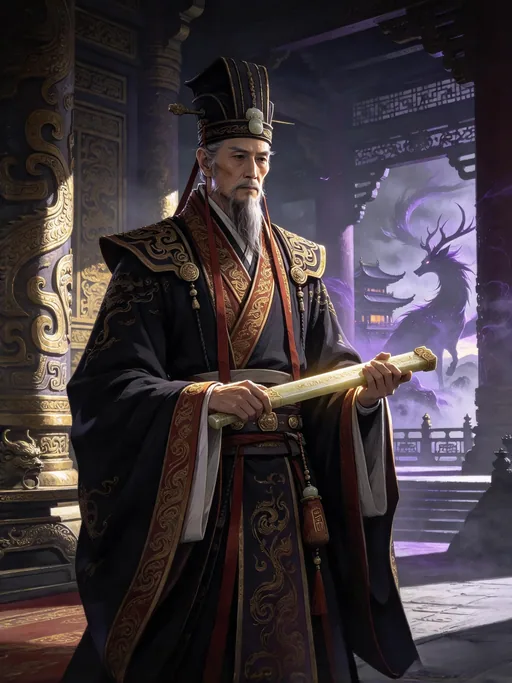
Bi Gan
MORTAL HEROES
比干
The youngest of the Sanxiao Sisters, a fiercely devoted and impulsive immortal who helped unleash the Nine-Meander Yellow River Formation, only to meet a tragic end at the hands of the supreme saints.
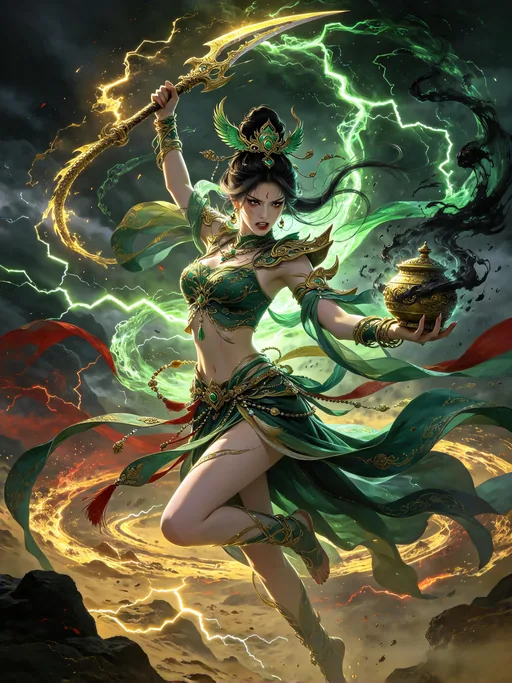
Bixiao Niangniang
IMMORTALS
碧霄娘娘
A beautiful maiden possessed by a thousand-year-old nine-tailed fox, sent by the goddess Nüwa to corrupt the Shang dynasty, only to be executed for her excessive cruelty.
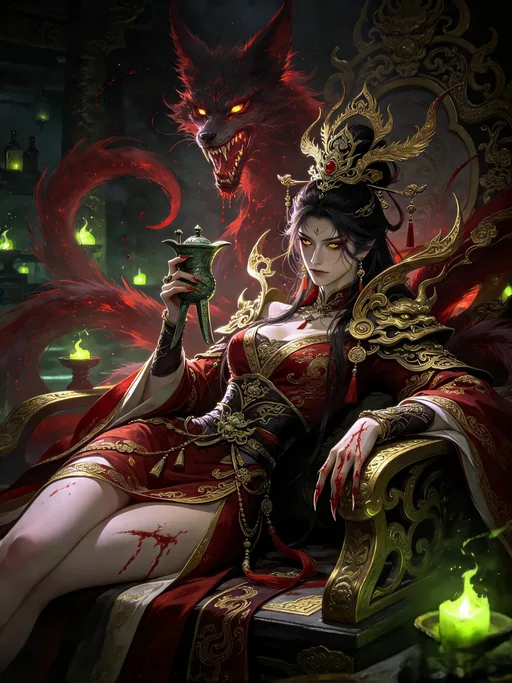
Da Ji
DEMONS
妲己
Deng Jiugong's daughter, a mortal general whose stones never miss a face. She wounded three Zhou champions and hit Kong Xuan three times when no immortal could touch him. Taken by a rope and married the same night to secure her father's defection, she fought for the Zhou until Gao Lanying blinded her with needles and cut her down. Enrolled as the Star of Six Harmonies.
Deng Chanyu
MORTAL HEROES
邓婵玉