Yang Ren
杨任Grand Councilor Yang Ren · Jiazi Taisui
Jiazi Taisui, the Year-God of the Sixty-Year Cycle
A Shang councilor who was blinded and killed for remonstrating against King Zhou, restored by an immortal with hands sprouting from his eye sockets and eyes in his palms, who then fought for Zhou and was apotheosized as the Year-God Taisui.
Oversight of the year's fortunes and misfortunes; the office of Taisui
Identity and Origins
Yang Ren enters the Fengshen Yanyi as a civil official, not a warrior. He is a grand councilor (大夫) of the Shang court, one of the senior ministers whose duty is to advise the throne. The novel places him in the early chapters, during the construction of the Deer Tower (鹿台), the extravagant palace project that Daji urges King Zhou to build. Yang Ren, like Bi Gan and Shang Rong before him, submits a memorial against the project. Unlike them, he is not merely dismissed. King Zhou orders his eyes gouged out and has him executed, and his body is thrown into the wilderness.
This is the novel's first fully developed martyrdom of a remonstrating official, and it establishes Yang Ren as a particular kind of hero: not a soldier, not an immortal, but a man whose weapon is speech and whose fate is to be destroyed for using it. His later transformation is therefore not a promotion but a restitution — the novel giving back, in supernatural form, what the tyrant took away.
Appearance and Iconography
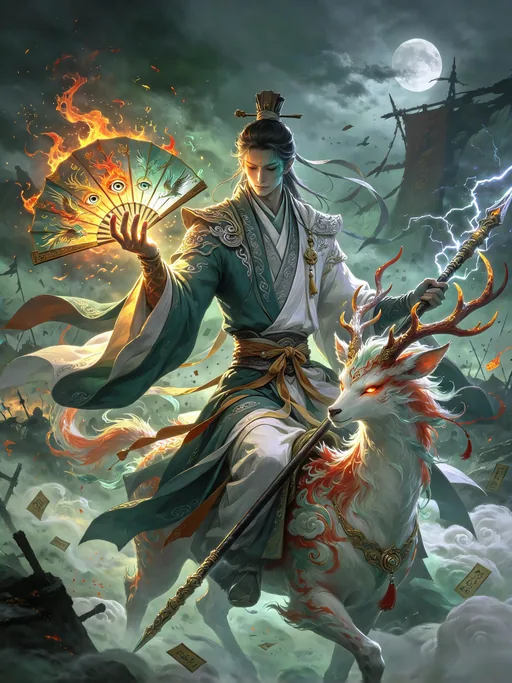
Yang Ren's restored form is one of the most striking images in the entire Fengshen corpus. Where his eyes were, two hands now grow from the sockets; in the palm of each hand, an eye opens. The eyes in his palms can see what ordinary eyes cannot — the novel says they can look up to the celestial courts and down into the underworld, and that nothing within the nine provinces escapes their gaze. He is, in effect, a living instrument of omniscient oversight.
His other attributes are equally specific. He wields the Five-Fire Seven-Bird Fan, a treasure given by his immortal teacher Qingxu Daode Zhenjun, which releases five kinds of fire and is particularly effective against the plague deities and fire-based enemies of the later campaigns. He carries the Flying-Lightning Spear and rides the Cloud-Radiance Beast, a mount whose hide shimmers with cloud and sunset colors. His silhouette is thus a deliberate paradox: a dignified Daoist-robed figure whose face is a site of controlled monstrosity — hands where eyes should be, eyes where hands should be, and a calm that makes the strangeness more unsettling rather than less.
Restoration and the Plague Campaigns
Yang Ren's body is found by Qingxu Daode Zhenjun, the immortal of Qingfeng Mountain, who recognizes that the dead councilor's loyalty deserves a second life. The immortal places two golden elixirs into the empty eye sockets. The flesh closes over them and then opens again — not as eyes, but as the bases of two arms, each ending in a palm with an eye. The novel does not explain the mechanism. It presents the restoration as a gift whose form is determined by the manner of the wound: because he was blinded for seeing too clearly, he is given sight that cannot be blinded.
Yang Ren then studies under the immortal and is sent down to assist Jiang Ziya at a moment when the Zhou camp is being ravaged by plague. The plague deities, led by Lü Yue, have spread disease through the camp, and conventional remedies fail. Yang Ren's fan, with its five fires, is one of the few weapons that can burn out the plague miasma. His campaign against Lü Yue and the plague spirits is his defining military episode: the blind councilor, now seeing more than anyone, drives back a foe that attacks the body rather than the battlefield.
The Investiture War
Yang Ren's role in the wider war is that of a specialist rather than a line commander. He is deployed where sight and fire are needed: against plague, against illusions, and against enemies who rely on concealment. His palm-eyes make him a natural counter to any foe who fights by hiding — a category that includes a great many of the Jie faction's immortals. The novel repeatedly uses him as the one who sees through a deception before anyone else does.
He fights through the later campaigns, including the mopping-up operations against the Shang remnants and the battles against the Meishan demons. His presence in these episodes gives the Zhou side an intelligence advantage that complements the brute force of figures like Nezha and the tactical command of Jiang Ziya. He is, in structural terms, the army's scout and seer — the one whose function is to make sure the Zhou commanders are not fighting blind.
Death and Apotheosis
Yang Ren is killed late in the war, during the campaign against the Meishan demons. The novel's account has him struck down by Yuan Hong, the white-ape demon who leads the seven monsters and who fights with a staff and a supernatural agility that even the Zhou immortals struggle to counter. Yang Ren's death is sudden and, in narrative terms, deliberately unspectacular: the seer who could see everywhere is killed by an enemy whose speed outruns sight itself.
After the war, Jiang Ziya enrolls him among the 365 gods as Jiazi Taisui, the Year-God of the first year of the sixty-year cycle. The office of Taisui is one of the most feared and most widely observed in Chinese popular religion: each year has its own Taisui deity, and the year's Taisui is believed to govern the fortunes of all who are born under conflicting signs. Yang Ren, the councilor who was destroyed for seeing too clearly, becomes the deity whose job is to oversee the fortunes of an entire year — a jurisdiction that is, in its own way, a form of total vision.
Cultural Legacy
Yang Ren's legacy in literature is the legacy of a body that records its own history. His palms and sockets are not decorative; they are the wound and the answer to the wound, made visible. Few characters in the Fengshen Yanyi carry their martyrdom so literally on their faces, and that literalism is why he is so often chosen for illustration and adaptation: he is a character whose design is also his argument.
In religious practice, his identity as Jiazi Taisui places him at the center of the Taisui cult, one of the most widespread folk observances in Chinese communities. Every year, devotees who believe they are "offending Taisui" (犯太岁) make offerings and seek propitiation, and the year's presiding Taisui is invoked by name. Yang Ren's position as the first of the sixty Taisui gives him a special prominence within that system.
For English-language readers, Yang Ren is also a useful introduction to a theme that runs through the entire Fengshen Yanyi: the idea that divine office is not a reward for virtue but a transformation of what a person suffered. He was blinded for speaking; he becomes the god whose eyes are everywhere. The novel does not soften the cruelty of his death. It converts it into a jurisdiction.
More from this collection
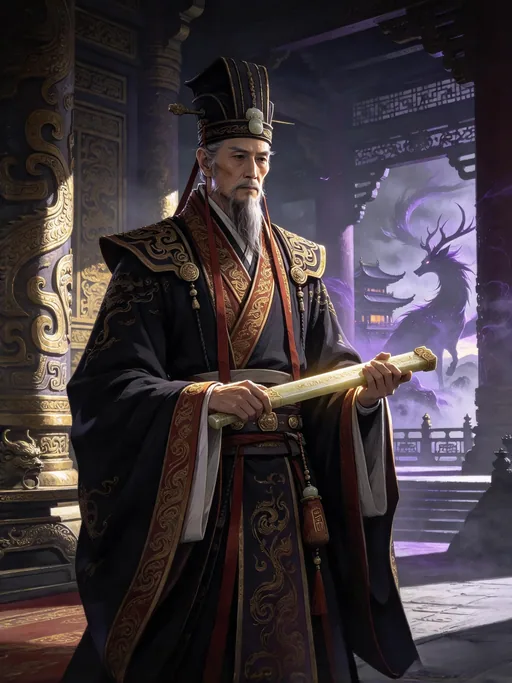
A Shang grand counselor and royal uncle of King Zhou, killed on Daji's demand for his seven-orifice heart. His death became one of the dynasty's defining crimes, and he was apotheosized as the Lord of the Wenqu Star.
Bi Gan
MORTAL HEROES
比干
The youngest of the Sanxiao Sisters, a fiercely devoted and impulsive immortal who helped unleash the Nine-Meander Yellow River Formation, only to meet a tragic end at the hands of the supreme saints.

Bixiao Niangniang
IMMORTALS
碧霄娘娘
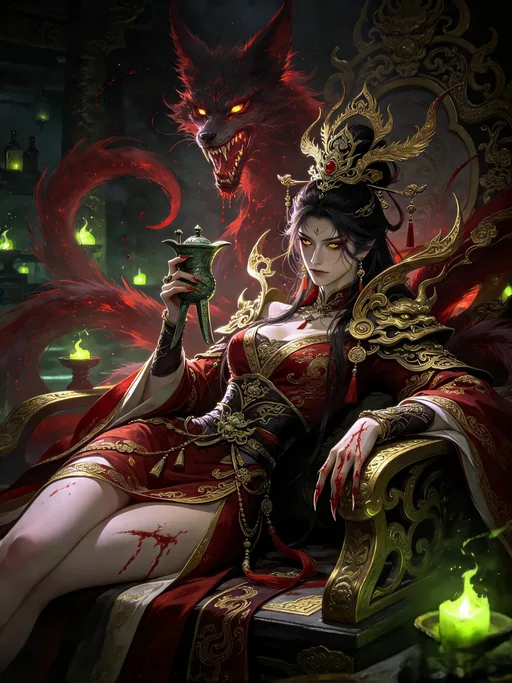
A beautiful maiden possessed by a thousand-year-old nine-tailed fox, sent by the goddess Nüwa to corrupt the Shang dynasty, only to be executed for her excessive cruelty.
Da Ji
DEMONS
妲己
Deng Jiugong's daughter, a mortal general whose stones never miss a face. She wounded three Zhou champions and hit Kong Xuan three times when no immortal could touch him. Taken by a rope and married the same night to secure her father's defection, she fought for the Zhou until Gao Lanying blinded her with needles and cut her down. Enrolled as the Star of Six Harmonies.

Deng Chanyu
MORTAL HEROES
邓婵玉