Yuan Hong
袁洪The White Ape of Meishan · Baiyuan Jing
The White Ape of Meishan, Chief of the Seven Monsters
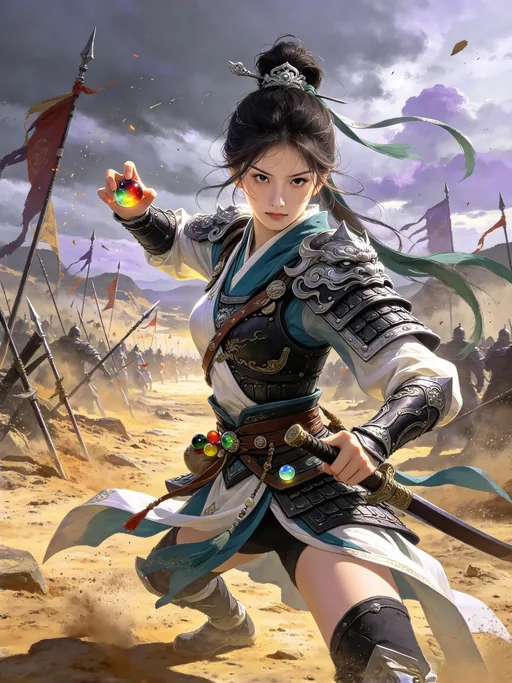
The white ape who answered King Zhou's call for champions and took command of the last Shang army at Mengjin, with six beast-spirits at his side. Beheaded, his head regrew; only the flying dagger could pin his spirit. Enrolled as the Star of the Four Follies.
Mountain wilderness, transformation, and the power of a spirit that cultivated without a sect
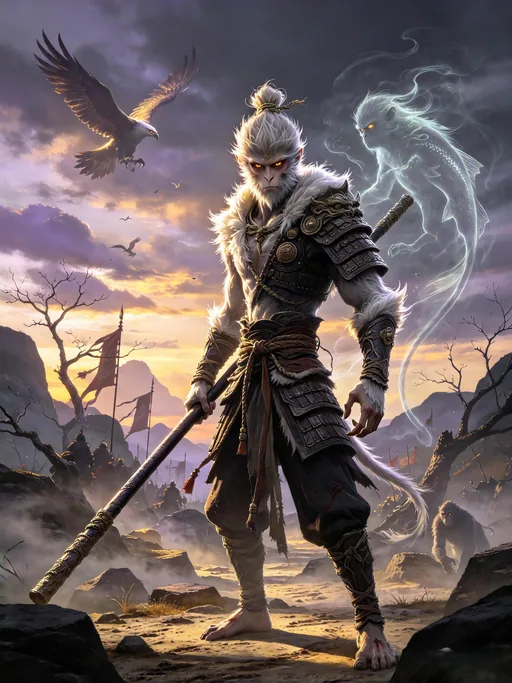
Answering the Notice
Yuan Hong is not a human being. He is a white ape who has cultivated on Mount Meishan long enough to take human form, and he enters the story in Chapter 88 not as a wanderer who stumbles into the war but as a volunteer. When King Zhou posts a notice calling for champions, three men from Meishan answer it — Yuan Hong, Chang Hao and Wu Long. The king makes Yuan Hong commander-in-chief, and it is his own proposal to take two hundred thousand troops and block the Mengjin crossing rather than march on Mianchi, because he does not want his supply road cut.
His origin puts him in a category the novel treats with a mixture of respect and unease: the spirit that cultivated without a sect. He is not a Jie disciple; he has no teacher, no lineage, and no place in the hierarchy this war is being fought over. His power is real — not a trick and not a borrowed treasure, but centuries of solitary work on one mountain. The other four of the seven arrive later and separately, each hiding his nature behind a borrowed surname, and Yuan Hong receives each with studied surprise, asking their names as though he did not already know them.
A Staff and a True Form
The novel gives him almost no physical description in human form. What it gives him is a weapon and a way of fighting: a wrought-iron staff, plain and unglamorous, and the habit of fighting from horseback. He carries no named treasure, and everything he does he does with his own body — which is the point, because the body is the treasure.
His true form is the white ape, and the novel treats the reversion as a revelation rather than a degradation: when he drops the human shape and rises into the air, the staff blow he lands on Yang Jian strikes sparks. The human form was the costume. His signature art is the eighty-nine transformations, the same order of power that Yang Jian possesses, and the novel is explicit that the contest is even — the two transform without end, each generating what counters the other, and neither gains. His six companions are his only allies, and the novel treats the seven as a single unit rather than a captain and his subordinates. That unit is also his weakness: each of the six is undone by the creature that naturally preys on him.
The Death of a Man Who Could See
His defining act does not happen in a duel. It happens at night, in the chaos of Jiang Ziya's raid on the Shang camp — the same night two Taoist scouts are destroyed by the Heaven-and-Net array and the divine whip.
Yang Ren, who has been the Zhou answer to concealment and illusion through the whole later campaign, sees the white light of Yuan Hong's manifested spirit rise from his head and reaches for his fan of five fires and seven birds. He is too slow. The spirit in the light lifts its staff and brings it down on the crown of his head. The man who could see everything is killed by something that moved faster than sight.
The novel makes the point structurally rather than in commentary: Yang Ren's power was sight, Yuan Hong's was speed, and in their one encounter speed won. The seer did not misread the situation — he read it correctly and did not have time to act on what he saw.
A Contest of Equals
The confrontation with Yang Jian is the novel's most extended demonstration of transformation combat. It begins in the burning camp and continues across open country: the ape rises in his true form and strikes sparks off Yang Jian's head, Yang Jian becomes a beam of golden light and answers from above, the ape becomes a column of white vapour and wraps it around himself. Neither lands a decisive stroke.
Then the pursuit. Yuan Hong flees toward Meishan and turns himself into a boulder beside the road; Yang Jian reads the transformation at a glance, becomes a stonemason with hammer and drill, and walks up to split it. The ape breaks the disguise and goes off as a gust of wind. At Meishan he has the advantage — a whistle brings hundreds of small monkeys out with sticks, and Yang Jian judges he cannot win there and leaves as a beam of light. The immortal the Zhou army most relies on has just been driven off the field by a mountain spirit's household, which is the novel's clearest statement that the war's final threat requires powers from outside the war.
Seven Against Seven
Yang Jian's solution is not a stronger spell but better information. He goes to the Yuzhu Cave on Mount Zhongnan and asks Yunzhong Zi for the Demon-Reflecting Mirror; Yunzhong Zi hands it over and names the enemy outright — these are the Seven Monsters of Meishan, and Yang Jian is the only one who can take them.
The mirror defeats no one; it identifies, and identification is the whole method, since each of the seven is beaten by what naturally preys on him. The great snake becomes a black fog and strikes; Yang Jian becomes a winged centipede and cuts him in two. The centipede turns to blue light; Yang Jian becomes a five-coloured rooster and pecks him apart. The boar swallows Yang Jian whole, and Yang Jian works on his liver from inside until the boar walks into the Zhou camp and kneels. The goat becomes white light; Yang Jian becomes a white-browed tiger and cuts him down. The mastiff spits a bowl-sized red pearl that drives off Nezha; Yang Jian's heavenly hound lets the pearl pass and seizes the dog instead. The water buffalo kills Zheng Lun with ox-yellow from his belly, and this one takes Nüwa herself, who sends a cyan-robed girl with a demon-binding rope to lead him away by the nose. Six of the seven are removed by matching a nature against a nature. Only the seventh requires something that is not a creature at all.
The Peach in the Painting
Yuan Hong's defeat is not a battlefield loss. It is a capture, and it takes a goddess to arrange. Nüwa appears a second time and gives Yang Jian the Mountain-and-River Seal, a treasure that unfolds into a landscape. He hangs it on a great tree, where it becomes a high mountain, lets himself be chased up it and vanishes; the ape follows. Inside, the rules are his own desires — think of mountains and there are mountains, think of water and there is water. He forgets himself and reverts to his true form, a sweet scent reaches him, and there on a branch hangs a peach. He climbs, picks it, eats it, and cannot stand: the peach has weighted his waist to the ground, and Yang Jian takes him by the scalp and binds him. The trap is not a cage but a world shaped to his own nature, and that is what makes it inescapable.
Then the detail that matters most. Yang Jian beheads him at the camp gate, and there is no blood: a thread of clear vapour rises from the neck, a white lotus blooms there, the flower opens and closes, and a new head is on his shoulders. It happens again and again. Decapitation, the one execution that ends everything, does not end him — so Jiang Ziya sets out an incense table, takes out a red gourd, and a small thing with brows and eyes appears in the air, its two beams of white light pinning the ape's body where it stands. The treasure turns two or three times, and the head is on the ground bleeding. The roster files him as the Star of the Four Follies, and his six companions get the same kind of office — not one of the seven receives a seat with dignity in it. The register takes them all and files them under damage, which is a verdict delivered structurally rather than morally: he was a power that could not be governed, and the system marks such powers as incomplete.
More from this collection
A Shang grand counselor and royal uncle of King Zhou, killed on Daji's demand for his seven-orifice heart. His death became one of the dynasty's defining crimes, and he was apotheosized as the Lord of the Wenqu Star.
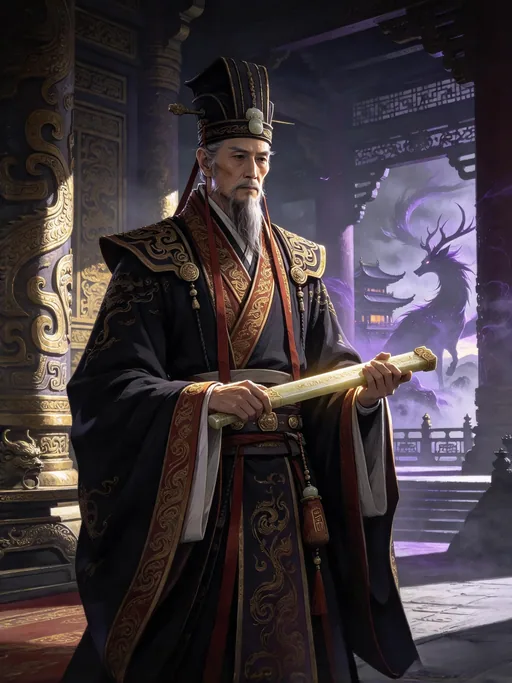
Bi Gan
MORTAL HEROES
比干
The youngest of the Sanxiao Sisters, a fiercely devoted and impulsive immortal who helped unleash the Nine-Meander Yellow River Formation, only to meet a tragic end at the hands of the supreme saints.
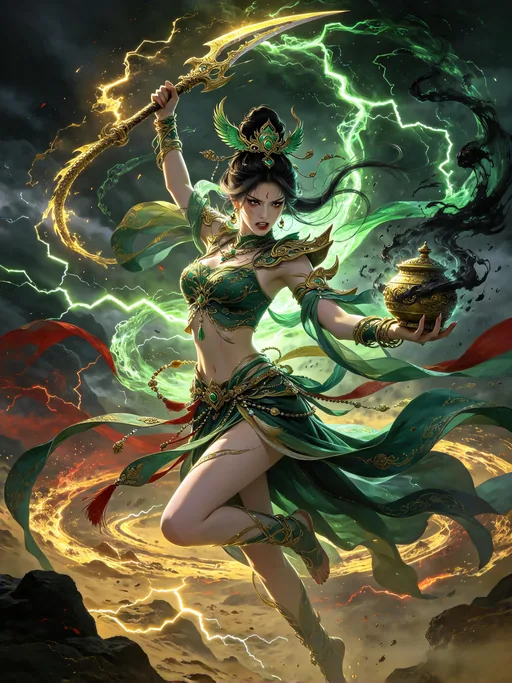
Bixiao Niangniang
IMMORTALS
碧霄娘娘
A beautiful maiden possessed by a thousand-year-old nine-tailed fox, sent by the goddess Nüwa to corrupt the Shang dynasty, only to be executed for her excessive cruelty.
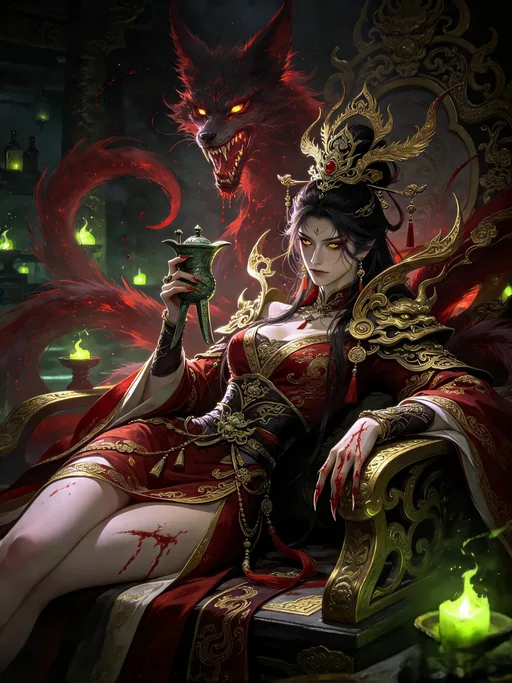
Da Ji
DEMONS
妲己
Deng Jiugong's daughter, a mortal general whose stones never miss a face. She wounded three Zhou champions and hit Kong Xuan three times when no immortal could touch him. Taken by a rope and married the same night to secure her father's defection, she fought for the Zhou until Gao Lanying blinded her with needles and cut her down. Enrolled as the Star of Six Harmonies.
Deng Chanyu
MORTAL HEROES
邓婵玉