Yunzhong Zi
云中子The Cloud-Midst Master · The Blessed Immortal of Zhongnan
The Cloud-Midst Master of Jade Pillar Cave, the Blessed Immortal of the Chan Teaching
A Chan immortal of Jade Pillar Cave on Mount Zhongnan, called the Blessed Immortal because the Nine-Bends Yellow River Formation never stripped his cultivation. He tried to drive the fox-demon out of the Shang court, raised Lei Zhenzi and gave him wings, and burned Wen Zhong to death at Dragon-Cutting Ridge.
Exorcism of demons, the fashioning of destined disciples, and the fire that consumes the unrepentant
Just Outside the Twelve
Yunzhong Zi is a cultivator of Jade Pillar Cave on Mount Zhongnan and a member of the Chan teaching under Yuanshi Tianzun — though, the novel is careful to note, not one of the Twelve Golden Immortals. He stands one step outside that famous circle: an immortal of the same generation, with his own cave, his own disciple and his own authority, but never counted among the twelve who dominate the novel's clerical politics. His attendant is a boy named Jinxia Tongzi.
Among the Chan immortals he carries a particular epithet — the Blessed Immortal — because he alone came through the Nine-Bends Yellow River Formation without having the three flowers struck from his crown and the five qi extinguished. Where the Twelve were maimed and forced to begin again, he came through intact, and the novel never explains why; it simply lets the title stand. That title also describes his narrative function, which is that of the outside adviser: he sees the Shang court from a distance, diagnoses its illness, and offers a remedy the court is too corrupted to accept. His defining acts are scattered across thresholds rather than massed on a battlefield — he appears at court, he appears on a mountain, he appears at the mouth of a valley with eight fire pillars already in place.
Three Instruments and a Furnace
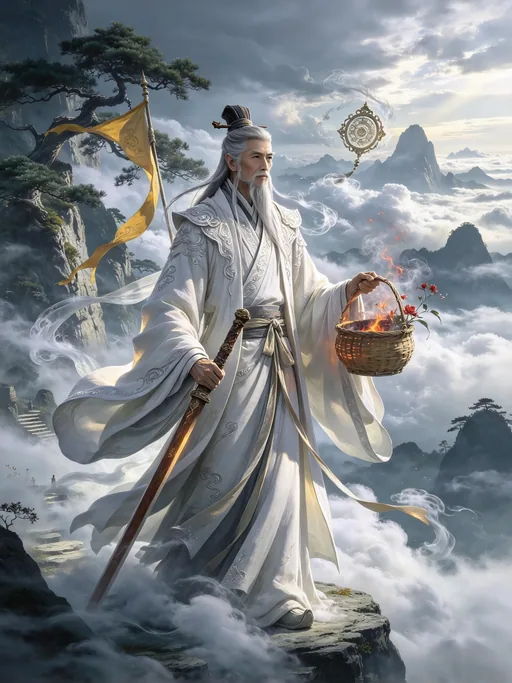
The novel gives him the iconography of the cloud-roaming Daoist rather than the armoured immortal: plain white robes, a simple crown, no weapon in the ordinary sense, and no mount — he travels on cloud, and his arrival is announced not by a herald but by a change in the air.
His instruments divide into two kinds. The diagnostic: the Demon-Revealing Mirror shows a demon its true form, and the novel later lends it to Yang Jian against Ma Shan and the Seven Monsters, though it fails entirely on Kong Xuan. The counter-active: the Water-and-Fire Flower Basket holds the two elemental extremes and catches an opponent's flying treasures, and in calmer days gathers herbs. The pine-wood sword is the classical instrument of exorcism, able to drive a demon out of a house, a body or a court. And a fourth belonging to neither kind: eight copper pillars set in the eight directions, each holding forty-nine fire-dragons, able to release the fire of air, stone, wood, the three souls and the human world at once — not a diagnostic tool but a furnace built to close around one man, which the novel saves for Wen Zhong.
The Sword at the Shang Court
His first appearance is at the Shang court, and it is an act of diagnosis rather than combat. A demonic aura hangs over the palace; the court is sick and does not know it. Yunzhong Zi arrives, observes, and identifies the source — a fox-demon has taken up residence in the person of the king's consort. He does not accuse Daji by name. He offers a remedy: a sword cut from an old pine bough, to be hung in the palace, which will drive the influence out.
King Zhou accepts it, and for a brief interval the palace begins to clear and Daji is thrown into visible distress. But she understands exactly what the object is, and persuades the king that it is an ill-omened thing aimed at the throne; he has it burned, the influence returns, and the court is sealed in its illness. The episode establishes the pattern of his career: he arrives with the correct diagnosis and the correct remedy and is rejected — not because the diagnosis is wrong, but because the patient prefers the disease. The novel does not treat this as a defeat. He does not fight; he withdraws, leaving a verse on the wall behind him. His function is to have offered the cure, not to have forced it.
The Child on Mount Yan
His second and more important intervention comes years later, and it is an act of creation rather than correction. Ji Chang, the Western Duke, is travelling toward the capital when a storm breaks over Mount Yan; after the thunder a child is found beside an ancient grave, and Ji Chang takes him as his hundredth son. Yunzhong Zi appears at once and asks to take the child as his disciple, promising to return him when the time comes.
On Mount Zhongnan he raises the boy, whom he names Lei Zhenzi, and when the boy is grown he plants two immortal apricots and lets him find and eat them. Wings of wind and thunder burst from his ribs; his face turns beaked and blue; he becomes a thunder-winged warrior. The novel presents this neither as blessing nor as curse but as a formation: the master has taken a mortal child and shaped him into the instrument his destiny requires. Then the golden rod, the staff technique, and the sending — at the exact moment Ji Chang needs saving at the pass. But the sending has a condition: after rescuing his father the boy must not follow him home, but return to the mountain and wait. His mentorship is precise rather than warm — he takes, he shapes, he arms, he sends, and then calls the weapon home until the hour it is needed.
Dragon-Cutting Ridge
His one great killing is not in a melee. It is a trap prepared well in advance. Wen Zhong, the Shang Grand Preceptor, is retreating west after his defeat, and the road he must take runs through a place called Dragon-Cutting Ridge — a name that has hung over him as a prophecy since his master forbade him ever to set foot on a ridge so named.
Yunzhong Zi is already there. Eight copper pillars stand in the eight directions, each charged with forty-nine fire-dragons; when Wen Zhong enters the ground between them the pillars erupt and the five fires close at once. The most formidable servant the Shang ever had is burned to ash in a furnace built for him. The novel gives Yunzhong Zi its highest compliment for a non-combatant: he wins the war's most consequential single kill without ever drawing a weapon in personal combat. His contributions are elsewhere — a diagnosis refused at court, a disciple made on a mountain, and eight pillars waiting at a ridge.
A Function, Not an Office
He does not appear on the Fengshen roster. He is not killed, judged and enrolled among the 365 gods; like the other surviving Chan immortals he comes through the war and returns to his mountain. The absence fits the role: the roster enrolls gods broken by the war and needing an office to steady them, while the title Blessed Immortal states that he was never broken at all. The outside adviser's reward is to go back outside.
In later tradition he is remembered less as a god than as a type — the hermit who appears at the threshold of great events, offers the correct remedy, and is either accepted or refused. Most of the novel's immortals are defined by what they destroy; he is defined by what he diagnoses and what he raises, and then once by what he burns. He tries to cure the court and fails, raises Lei Zhenzi and succeeds, closes a ridge around Wen Zhong and ends the Shang's last hope in the west, and the novel sets the three side by side without comment. His authority comes from seeing clearly, and his tragedy is that clear sight is not always welcome.
More from this collection
A Shang grand counselor and royal uncle of King Zhou, killed on Daji's demand for his seven-orifice heart. His death became one of the dynasty's defining crimes, and he was apotheosized as the Lord of the Wenqu Star.
Bi Gan
MORTAL HEROES
比干
The youngest of the Sanxiao Sisters, a fiercely devoted and impulsive immortal who helped unleash the Nine-Meander Yellow River Formation, only to meet a tragic end at the hands of the supreme saints.
Bixiao Niangniang
IMMORTALS
碧霄娘娘
A beautiful maiden possessed by a thousand-year-old nine-tailed fox, sent by the goddess Nüwa to corrupt the Shang dynasty, only to be executed for her excessive cruelty.
Da Ji
DEMONS
妲己
Deng Jiugong's daughter, a mortal general whose stones never miss a face. She wounded three Zhou champions and hit Kong Xuan three times when no immortal could touch him. Taken by a rope and married the same night to secure her father's defection, she fought for the Zhou until Gao Lanying blinded her with needles and cut her down. Enrolled as the Star of Six Harmonies.

Deng Chanyu
MORTAL HEROES
邓婵玉