Qingxu Daode Zhenjun
清虚道德真君Perfected Lord of Pure Void and Virtue · The Immortal of Green Peak Mountain
Perfected Lord of Pure Void and Virtue
A Perfected Lord of the Chan Teaching's Twelve Golden Immortals, based at Green Peak Mountain's Ziyang Cave, who raised Huang Tianhua from childhood, restored the blinded Yang Ren, and supplied both disciples with the treasures that shaped their fates.
Cultivation of virtue and the transmission of treasures to worthy disciples
Identity and Origins
Qingxu Daode Zhenjun is one of the Twelve Golden Immortals of the Chan Teaching, the senior disciples of Yuanshi Tianzun who form the backbone of the Zhou side's immortal leadership. His seat is Green Peak Mountain's Ziyang Cave (青峰山紫阳洞), a secluded cultivation site far from the political centers of the Shang and the military camps of the Zhou. The novel gives him no dramatic origin story; he is simply present, from his first appearance, as a figure of established authority.
His name is a program rather than a biography. "Qingxu" means pure void; "Daode" means virtue and its power; "Zhenjun" is the title of a Perfected Lord. The name describes a cultivator whose authority rests on inner refinement rather than martial accumulation. This matters because his narrative function is precisely that of the refiner: he takes raw material — a stolen child, a blinded corpse — and returns it to the world as something shaped and armed.
Among the Twelve, he is not the most prominent in battle. He is not Guang Chengzi, who trains the emperor; he is not Taiyi Zhenren, who rebuilds Nezha from lotus. He is the master of two specific disciples, Huang Tianhua and Yang Ren, and his importance in the novel is concentrated in what he does for them.
Appearance and Iconography
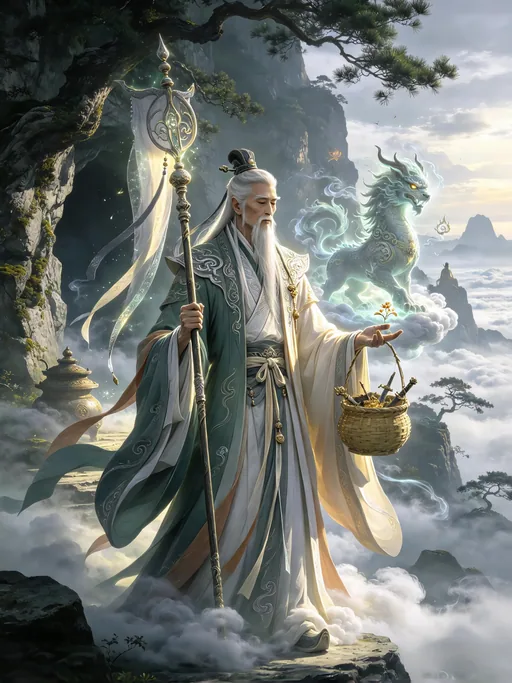
The novel gives Qingxu Daode Zhenjun the standard iconography of a senior Chan immortal: a Daoist crown, layered robes in subdued colors, a long beard, and an expression of settled calm. He travels on cloud rather than on a mount, and he carries a mixed set of treasures that are, in effect, a portable armory for his disciples.
His personal treasures include the Mixed-Origin Banner (混元幡), a banner used to obscure and protect, and the Mo Xie Sword (莫邪宝剑), a blade of great sharpness. The treasures he gives away are more famous than the ones he keeps. To Huang Tianhua he gives the two eight-edged silver hammers, the Heart-Piercing Nails (攒心钉), the Fire-Dragon Dart (火龙标), the Mo Xie Sword, and the flower basket that catches enemy weapons. To Yang Ren he gives the Five-Fire Seven-Bird Fan (五火七禽扇), the Flying-Lightning Spear (飞电枪), and the Cloud-Radiance Beast.
This distribution is his real iconography. He is visualized less by what he holds than by what his disciples hold because of him. In group depictions of the Twelve Golden Immortals, he is the one whose silhouette is surrounded by the silhouettes of his students' weapons.
The Theft of Huang Tianhua
Qingxu Daode Zhenjun's first intervention in the narrative is an abduction that the novel presents without apology. Huang Tianhua, aged three, is playing in the garden of the Huang household when the immortal descends, lifts the child, and carries him away to Green Peak Mountain. The family is left to believe the boy is lost. The novel does not frame this as a crime. It frames it as the claim of a master on a disciple whose destiny requires removal from the ordinary world.
This is a recurring pattern in the Fengshen Yanyi: immortals take children, and the taking is justified by the child's future role in the war. What makes Qingxu's version distinctive is the length of the separation and the emotional cost it imposes on Huang Feihu. Thirteen years pass. When Huang Tianhua descends the mountain, he does so to save a father who does not recognize him. The master who took the child is also the master who sends him back at the exact moment the father needs saving.
The novel does not ask whether this is cruel. It asks the reader to notice that the return is timed. Qingxu Daode Zhenjun's mentorship is not warm, but it is precise.
The Restoration of Yang Ren
The second and more spectacular intervention comes with Yang Ren, the Shang councilor who was blinded and killed for remonstrating against King Zhou. His body is thrown into the wilderness. Qingxu Daode Zhenjun finds it, recognizes the loyalty in the corpse, and decides that such a death should not be final. He places two golden elixirs into the empty eye sockets. The flesh closes, then opens again — not as eyes, but as the roots of two arms, each ending in a palm with an eye.
The novel does not explain the mechanism, and Qingxu does not explain it either. He simply performs the restoration and then takes Yang Ren as a disciple, training him on Green Peak Mountain until he is ready to descend and join the Zhou campaign. The restoration is the most vivid single act attributed to any of the Twelve Golden Immortals. It is also the clearest statement of Qingxu's narrative identity: he is the master who gives back what violence has taken, but in a form that records the violence.
Yang Ren's palm-eyes are therefore not a punishment or a curiosity. They are Qingxu's answer to King Zhou's cruelty — a body rebuilt so that the wound becomes the instrument. The master who could not prevent the blinding makes the blinding into a form of sight.
The Investiture War
Qingxu Daode Zhenjun's own combat record in the Investiture War is respectable but not central. He participates in the breaking of the Ten Absolute Formations, where the Twelve Golden Immortals are deployed as the Chan side's answer to the Jie faction's formation masters. He fights at the Ten Thousand Immortals Formation, the war's final convergence, alongside Laozi, Yuanshi Tianzun, and the other Golden Immortals. These are ensemble scenes; the novel does not single him out for a decisive individual victory.
His importance in the war is logistical and pedagogical. He arms two of Zhou's most distinctive fighters. He restores one of them from death. He times the descent of the other to the exact moment his father needs rescue. In a war that is fought with treasures as much as with troops, the immortal who distributes treasures is doing a different kind of work from the immortal who swings a sword.
This is also why he is a useful figure for understanding how the Chan Teaching operates. The Twelve Golden Immortals are not a uniform block of warriors. Some, like Guang Chengzi, are political operators; some, like Taiyi, are rebuilders of bodies; some, like Qingxu, are quartermasters of destiny, whose function is to make sure the right weapon reaches the right hand at the right chapter.
Fate, Apotheosis, and Legacy
Qingxu Daode Zhenjun does not appear on the Fengshen roster. Like the other Twelve Golden Immortals, he survives the war without being killed, judged, and enrolled among the 365 gods; his fate is the fate of the Chan leadership — back to his mountain, his cave and his cultivation, having taken part in the war without being consumed by it. Nor does the novel give him a dramatic ending. His narrative closure is distributed across his disciples instead: Huang Tianhua dies at Golden Rooster Ridge and becomes Bingling Gong, Yang Ren dies against Yuan Hong and becomes Jiazi Taisui. The master who restored and armed them receives no throne of his own. He receives two gods who call him master.
His legacy is that of a supporting figure who is nevertheless structurally indispensable. He has no cult of note, no temple tradition, no myth cycle of his own; what he has is a place in the machinery that cannot be removed without collapsing two of the novel's most memorable arcs. Remove him, and Huang Tianhua has no master, no treasures and no prophecy to violate; remove him, and Yang Ren stays a blinded corpse in the wilderness. He also illustrates how this book thinks about mentorship. Masters here are not wise elders who dispense advice: they take children, restore corpses, hand out weapons, and time their interventions to the needs of a cosmic war. His virtue is measured not by what he says but by what he gives, and by when he gives it.
More from this collection
A Shang grand counselor and royal uncle of King Zhou, killed on Daji's demand for his seven-orifice heart. His death became one of the dynasty's defining crimes, and he was apotheosized as the Lord of the Wenqu Star.
Bi Gan
MORTAL HEROES
比干
The youngest of the Sanxiao Sisters, a fiercely devoted and impulsive immortal who helped unleash the Nine-Meander Yellow River Formation, only to meet a tragic end at the hands of the supreme saints.
Bixiao Niangniang
IMMORTALS
碧霄娘娘
A beautiful maiden possessed by a thousand-year-old nine-tailed fox, sent by the goddess Nüwa to corrupt the Shang dynasty, only to be executed for her excessive cruelty.
Da Ji
DEMONS
妲己
Deng Jiugong's daughter, a mortal general whose stones never miss a face. She wounded three Zhou champions and hit Kong Xuan three times when no immortal could touch him. Taken by a rope and married the same night to secure her father's defection, she fought for the Zhou until Gao Lanying blinded her with needles and cut her down. Enrolled as the Star of Six Harmonies.
Deng Chanyu
MORTAL HEROES
邓婵玉