Yin Hong
殷洪The Second Prince of Shang
Wu Gu Xing, the Grain Star
The younger son of King Zhou, disciple of Chi Jingzi, who broke his own oath on the road to Western Qi and was reduced to ashes inside the Supreme Ultimate Diagram.
Grain and harvest, among the stars that attend the Dipper
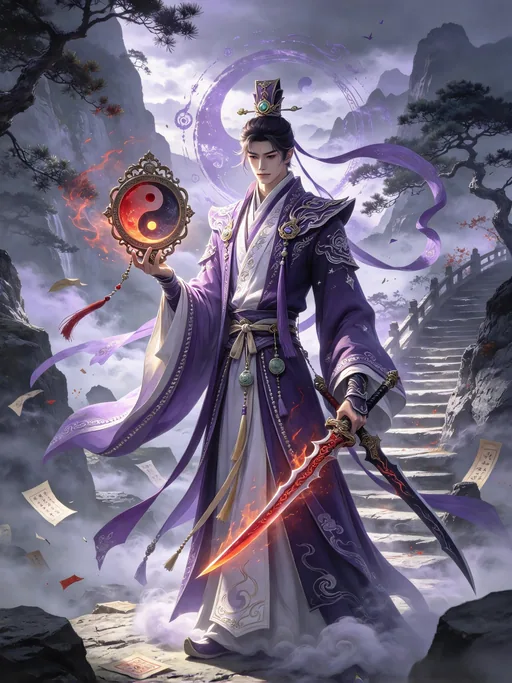
The Second Son
Yin Hong is the younger son of King Zhou and Queen Jiang, and the brother of Yin Jiao. He is not the heir and never will be; his function in the family is to be the spare. That does not save him. When their mother is destroyed by Daji's intrigue and the king orders both boys executed, the same two palace officers carry them out of the capital on their backs and the same general, Huang Feihu, lets them pass. They are retaken, and the same wind takes them away — Yin Jiao to Mount Jiuxian, Yin Hong to Mount Taihua, where Chi Jingzi becomes his master.
The brothers run on nearly parallel tracks and end in two different offices. One is ploughed into a mountain ridge; the other is burned to ash in a diagram. What separates them is small and worth watching: both swear an oath on the way down the mountain, both break it for the same reason, and both are killed by the exact words they used.
A Mirror with Two Faces
Chi Jingzi gives his disciple the contents of the cave: the Yin-Yang Mirror, the purple-ribbon robe, the water-and-fire blade, and a halberd. The mirror is the famous object. It has two faces, and they do opposite things — one glance in one direction drops a man from the saddle, and the other face brings him back up. In practice Yin Hong uses it less as a weapon than as a way of demonstrating that he could kill anyone he wanted and is choosing not to.
The robe turns out to be more valuable than the mirror. Nezha's spear goes in and does not go through; the rod that is made to strike down anyone whose name is on the roster has no effect on him at all, because the garment simply refuses the blow. This is worth noting, because it means his defence was better than his offence. He could not be hurt by the weapons the Zhou camp relied on. What killed him in the end was not a weapon but paperwork — a diagram borrowed from a higher authority, and a colleague in the sky reminding his master not to miss the hour.
Four Chiefs on a Mountain Road
On the way to Western Qi he passes through the Green Peak Ridge of Mount Erlong and takes over a bandit camp: Pang Hong, Liu Fu, Gou Zhang and Bi Huan, with three thousand men. He converts them to Zhou colours, burns their stockade, and marches them west. One of the four asks him the obvious question — you are a Shang prince, why are you helping Zhou? — and Yin Hong gives a clear answer: the king has destroyed the order of things and lost the way of a ruler, the world has turned from him, and a son who follows heaven does not thereby wrong his father.
That answer matters for what happens later. He is not a confused boy being led astray; at this point he has thought it through and can defend it. The novel is establishing that his defection later is not a failure of intelligence. Shen Gongbao will not argue that he is wrong about the king. He will change the subject to something Yin Hong has no answer for.
A Toothache Curse
Shen Gongbao rides up on a tiger — his own tiger, he explains, harmless — and makes the case in three moves. A son does not take up arms against his father. There is no heir after the king, so the ancestral temples and the altars of the state will pass into other hands. And when he goes down to the underworld, what face will he show his first ancestor? Yin Hong wavers, and then raises the only objection he has: he has sworn an oath. If he does not help Zhou, he has said, let his four limbs become flying ash.
Shen Gongbao laughs. A toothache curse, he calls it — the kind of thing people say and no one collects; whoever heard of flesh turning to ash? And Yin Hong accepts this. That is the whole turning point. Nothing is refuted; the oath is simply reclassified, from a contract with heaven to a figure of speech. The novel has already told the reader that these vows are collected to the letter, and it lets the most casual line in the book do the work: a man is not undone by an argument he loses, but by being persuaded that his own word was never serious.
The Diagram That Gives You What You Think Of
Chi Jingzi comes down to talk him back and fails; the disciple even turns his master's own mirror on him. So the master borrows the Supreme Ultimate Diagram, and spreads it on the ground. What happens inside it is the strangest death scene in the book: whatever Yin Hong thinks of arrives. He wonders whether there is an ambush, and an ambush charges; he thinks of seizing Jiang Ziya, and Jiang Ziya is there; he thinks of going home to see his father, and he is through the palace gate. It is a place where every wish is granted immediately and none of them is real.
Then he thinks of his mother. She appears, and she is not there to comfort him: she tells him that he would not listen to his master, that he took up arms for a king without the way against one with it, and that he swore his flesh would become ash and is now standing in the place where that happens. He calls for her to save him and she is gone. Chi Jingzi appears, and Yin Hong weeps and offers to serve Zhou after all; his master hesitates — the novel says so — and it is Cihang Daoren, from mid-air, who says the mandate is what it is and the hour of the roster should not be missed. The diagram closes. He becomes ash. He is not executed by an angry teacher; he is processed.
The Grain Star
The roster enrols him among the stars that attend the Dipper, with the title Grain Star — a small office in a long list, wedged between a murderous star and a blade star. The novel has already told the reader this on its first page, where the two princes appear at court and the narrator notes in passing what each of them will become: one the Year-God, one the god of grain.
Taken together the two offices are more interesting than either one alone. Taisui governs whether the coming year goes well; the Grain Star governs whether there is enough to eat. Those are the two questions a farming society actually asks of heaven, and the novel has answered both by appointing two murdered princes to them. Yin Hong himself is barely worshipped anywhere; he has no temple of his own and no festival. But as a placement he is exact: the brother who died for a father is put in charge of the year, and the brother who died for a word is put in charge of the harvest — as if the book wanted to file them where their deaths would at least be useful.
More from this collection
A Shang grand counselor and royal uncle of King Zhou, killed on Daji's demand for his seven-orifice heart. His death became one of the dynasty's defining crimes, and he was apotheosized as the Lord of the Wenqu Star.
Bi Gan
MORTAL HEROES
比干
The youngest of the Sanxiao Sisters, a fiercely devoted and impulsive immortal who helped unleash the Nine-Meander Yellow River Formation, only to meet a tragic end at the hands of the supreme saints.
Bixiao Niangniang
IMMORTALS
碧霄娘娘
A beautiful maiden possessed by a thousand-year-old nine-tailed fox, sent by the goddess Nüwa to corrupt the Shang dynasty, only to be executed for her excessive cruelty.
Da Ji
DEMONS
妲己
Deng Jiugong's daughter, a mortal general whose stones never miss a face. She wounded three Zhou champions and hit Kong Xuan three times when no immortal could touch him. Taken by a rope and married the same night to secure her father's defection, she fought for the Zhou until Gao Lanying blinded her with needles and cut her down. Enrolled as the Star of Six Harmonies.
Deng Chanyu
MORTAL HEROES
邓婵玉