Yin Jiao
殷郊The Eldest Prince of Shang
Zhi Nian Taisui, the Year-God of the Current Year
The eldest son of King Zhou, saved from execution by the immortals, made a three-headed general by a handful of beans, and enrolled after death as the Year-God Taisui.
The fortunes and misfortunes of the current year, and the taboo on disturbing the earth
The Eldest Son of a Dynasty That Is Ending
Yin Jiao is the eldest son of King Zhou and Queen Jiang. If nothing changes, he will be the next king of Shang. Everything that follows in his story is set in motion by the fact that this stops being true: his mother is destroyed by Daji's intrigue, blinded and burned at the hands, and the king orders both of his sons executed.
They do not die there. Two palace officers, Fang Bi and Fang Xiang, each carry a boy out of the capital on their backs; Huang Feihu, sent in pursuit, lets them pass. They are caught again and brought back to the block, and this time it is the immortals who intervene — Guangchengzi and Chi Jingzi pass through, raise a wind, and take the two princes away. Yin Jiao goes to Mount Jiuxian as Guangchengzi's disciple, and his brother Yin Hong to Mount Taihua under Chi Jingzi. The novel uses the elder brother for a specific purpose: he is what a throne looks like when the mandate has already left it.
Three Heads, Six Arms
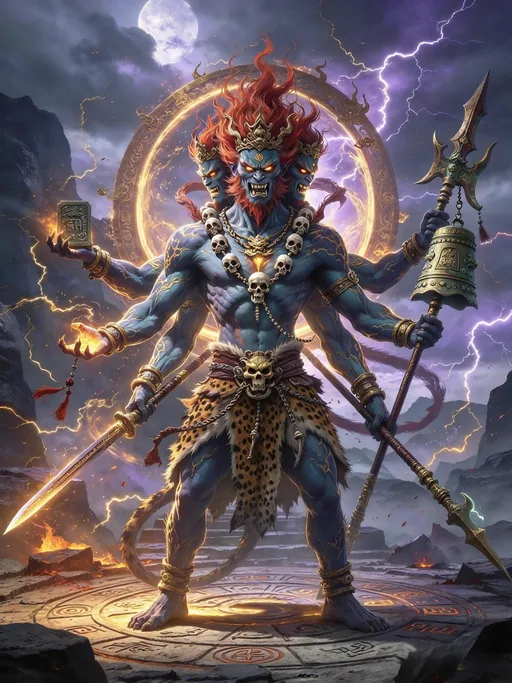
His transformation is not the result of years of discipline. Guangchengzi sends him out to find a weapon at the cliff behind the cave, and in a hollow he finds a stone table with six or seven steaming beans on it. He eats one, then all of them, and his bones begin to move. An arm pushes out of each shoulder; then a second head, and a third. What comes back to his master is a figure with a blue face, cinnabar hair, tusks above and below, and an extra eye in the forehead.
Guangchengzi's reaction is not alarm but approval, and he hands over the weapons: a halberd, the Heaven-Flipping Seal, the Soul-Shaking Bell, and a pair of swords. The seal is the one that matters. It is thrown into the air and comes down on a target with the weight of a mountain; in his first engagement it knocks Nezha off his fire-wheels. The bell is subtler — it does not kill but unseats, shaking a rider out of the saddle so that he can be taken alive. Between them they make him, for a few chapters, the most difficult opponent the Zhou camp has faced. It is worth noticing how cheap his divinity was: a handful of unlabeled food in an empty cave, eaten out of curiosity.
The Sentence He Spoke on the Way Down
Before he leaves, Guangchengzi gives him the usual instruction: go east, help Zhou, do not change your mind. Yin Jiao answers with a vow — if he breaks his word, he says, let him suffer the punishment of the plough. Then he goes down the mountain and meets Shen Gongbao on the road, and the whole plan comes apart in the space of one conversation.
Shen Gongbao's argument is not about power. It is about blood: a son does not raise an army against his father; the ancestral temples and the altars of the state will pass to other hands; and his brother is already dead — killed, in fact, by the Zhou side. Yin Jiao turns around. The novel is careful to give him a motive that is not ambition: he goes back to avenge his brother. He does not notice that he has just made his own sentence executable. The book's rule is stated plainly and applied without exception: what a disciple says on the way down the mountain is a contract, and the mountain will collect.
The Seal and the Four Banners
He wins his first exchanges decisively. The seal drops Nezha out of the air; the bell shakes Huang Tianhua off his jade qilin and Huang Feihu off his five-coloured ox, and both are taken. Then Yin Jiao recognises the prisoner, comes down from the command tent himself, unties him, and lets father and son go — because years earlier this was the man who let two condemned princes ride out of the passes. It is one of the few moments in the book where an old debt outranks the war, and it establishes that he is not a traitor by temperament, only by oath.
The Zhou camp cannot answer the seal by force, so it answers administratively. Randeng works out that five banners must be set in five directions, and each one belongs to a different authority: the central yellow banner from the Jade Void palace, the southern flame banner from the Grand Thearch of the Profound Capital, the eastern blue lotus banner from the Western Paradise, the western cloud banner from the Queen Mother of the Jade Pool — which has to be fetched by the Old Man of the South Pole, since nobody else may enter. Guangchengzi travels to all of them in turn; the Western teacher refuses at first, on the grounds that a lotus banner should not be dragged into the dust of the world, and only relents when another Western sage argues the political case. Then the four banners are planted, and the north is deliberately left open. It is not an oversight. It is a funnel.
Mount Qi
Driven north, he finds the paths narrowing until he has to lead his horse on foot. He prays aloud: if his father still holds the mandate, let this one throw of the seal open a road through the mountain, and Shang still stands; if it does not open, he is finished. The seal strikes, the mountain splits, and for a moment he believes the answer is yes. The road it opens runs straight into the Zhou army, and the only way left is upward through the earth.
His head breaks the surface of a mountain ridge, and Randeng closes his hands. The two peaks press together with his body inside and his head outside. Then Guangchengzi drives the plough up the slope and a soldier named Wu Ji guides it across the neck. The instrument is a farm tool, not a weapon, and that is the point: the vow was a farmer's curse, and it is collected in a field. The chapter's closing couplet says that both brothers died exactly as they had sworn. It is not quite a moral. It is a receipt.
The Year-God
The roster gives him the office of Zhi Nian Taisui, the Year-God who sits over the current year and governs its good and ill fortune. He is invested on the same altar as Yang Ren, who receives the parallel office of Jiazi Taisui. His staff list reads like a small archive of his life: the Day-Walking God is Wen Liang, the general who died serving him; the Road-Opening God and the Path-Revealing God are Fang Bi and Fang Xiang, the two officers who once carried him and his brother out of the capital on their backs. The men who saved him as a child end up as the outriders of his divine procession.
In later religion Taisui is not a person but a position — sixty year-gods in rotation, and the one on duty for your year is the one you must not offend. The popular phrase about provoking the year-god onto his own head comes from this, and so does the custom of making offerings at the start of a year to be reconciled with him. Folk images of Taisui usually show a blue-faced, red-haired figure with three heads and six arms, which is not how Daoist scripture describes him but exactly how this novel does. That is the novel's most durable export: not a character, but a face, painted onto an office that had been an abstraction. And the book announces the office on its first page, before the prince has done anything at all — the ending is printed in the table of contents.
More from this collection
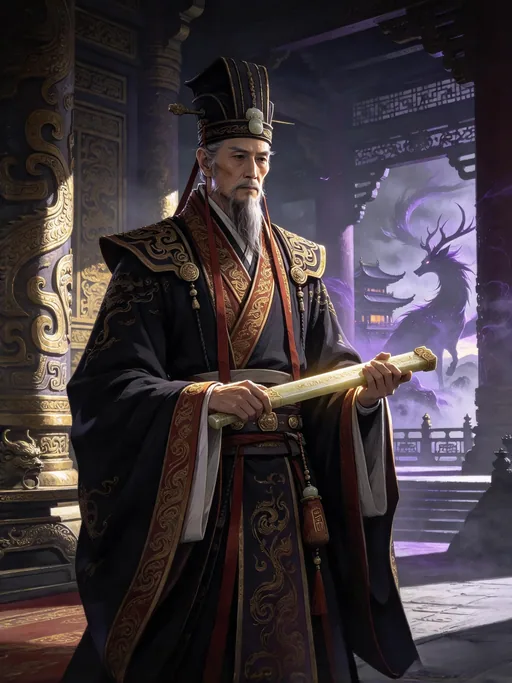
A Shang grand counselor and royal uncle of King Zhou, killed on Daji's demand for his seven-orifice heart. His death became one of the dynasty's defining crimes, and he was apotheosized as the Lord of the Wenqu Star.
Bi Gan
MORTAL HEROES
比干
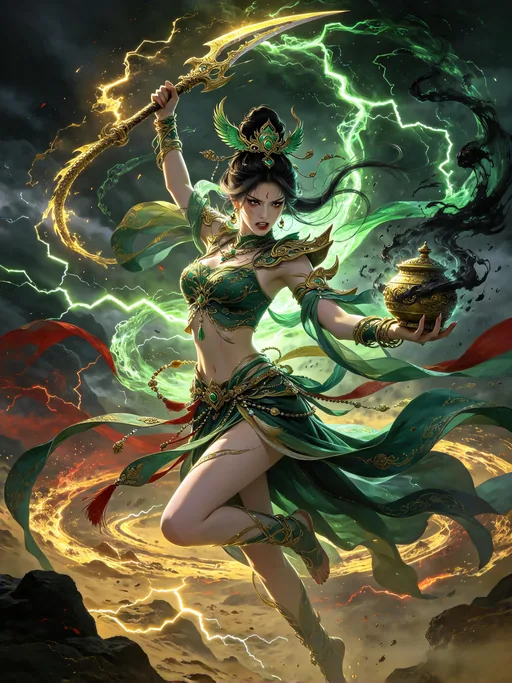
The youngest of the Sanxiao Sisters, a fiercely devoted and impulsive immortal who helped unleash the Nine-Meander Yellow River Formation, only to meet a tragic end at the hands of the supreme saints.
Bixiao Niangniang
IMMORTALS
碧霄娘娘
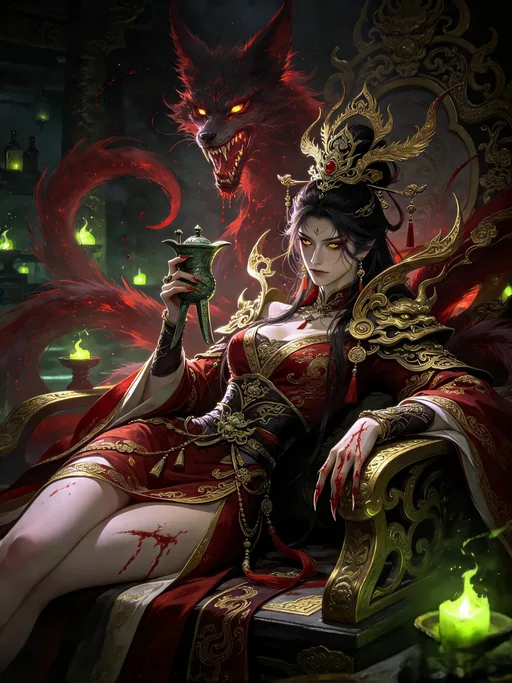
A beautiful maiden possessed by a thousand-year-old nine-tailed fox, sent by the goddess Nüwa to corrupt the Shang dynasty, only to be executed for her excessive cruelty.
Da Ji
DEMONS
妲己
Deng Jiugong's daughter, a mortal general whose stones never miss a face. She wounded three Zhou champions and hit Kong Xuan three times when no immortal could touch him. Taken by a rope and married the same night to secure her father's defection, she fought for the Zhou until Gao Lanying blinded her with needles and cut her down. Enrolled as the Star of Six Harmonies.
Deng Chanyu
MORTAL HEROES
邓婵玉